There is a famous quote by venture capitalist Peter Thiel regarding the disappointment of modern technology: “We wanted flying cars, instead we got 140 characters.” For decades, that was true. The “Flying Car” was the ultimate symbol of a broken promise. It was something that belonged in The Jetsons or Blade Runner, not in our driveways.
But as we approach 2026, the dream of vertical flight is finally becoming a certified reality. They are not called flying cars (because they don’t drive on roads); they are called eVTOLs (Electric Vertical Take-off and Landing aircraft). Think of them as giant, passenger-carrying drones. And unlike the sci-fi movies, they are quiet, they are electric, and they are landing in a city near you sooner than you think.
Why Now? The Convergence of Tech Why didn’t we have this in 2010? Two reasons: Batteries and Software. Flying requires massive amounts of energy. Heavy jet fuel works, but it’s loud and dirty. With the recent revolution in energy density (see our report on [Solid-State Batteries]), we can finally power heavy aircraft with electric motors. Furthermore, “Distributed Electric Propulsion” (using 6 or 12 small rotors instead of one giant one) allows for computerized stability. You don’t need to be a Top Gun pilot to fly these; the computer does 90% of the balancing work.
Not a Helicopter: The “Silence” Factor The biggest enemy of urban flight isn’t gravity; it’s Noise. Helicopters are loud. The “whop-whop” sound of a rotor cutting through the air shakes windows and wakes up neighborhoods. You can’t put a helipad in a suburb without getting sued.
eVTOLs are different. Companies like Joby Aviation and Archer have designed aircraft that blend into the background noise of a city. Joby claims their aircraft is 100x quieter than a helicopter during take-off. From 500 feet away, it sounds like a passing refrigerator or rustling leaves. This “acoustic stealth” is the key that unlocks skyports in downtown Los Angeles, New York, and London.
The “Uber of the Sky” Model The business model isn’t selling these planes to individuals (yet). It’s Ridesharing. United Airlines and Delta have already placed billion-dollar orders. The plan is to shuttle passengers from downtown “Vertiports” to the main airport.
The Problem: A drive from Manhattan to JFK Airport can take 90 minutes in gridlock traffic.
The Solution: An eVTOL flight takes 7 minutes.
The Cost: The goal is to price it competitively with an Uber Black (roughly $100-$150 per trip initially, dropping to Uber X prices as scale increases).
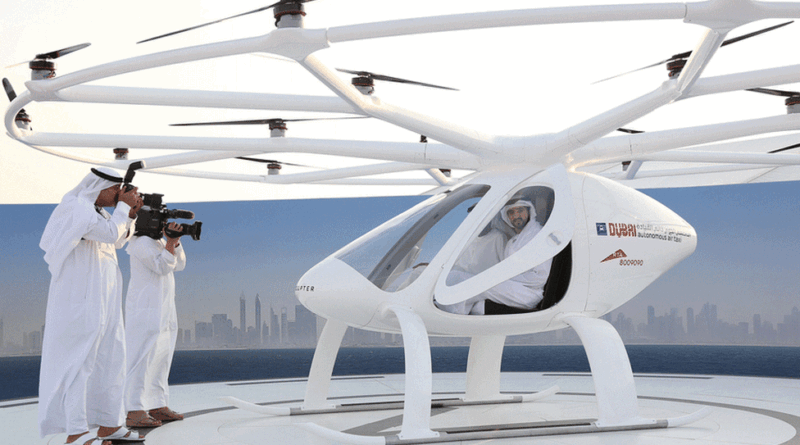
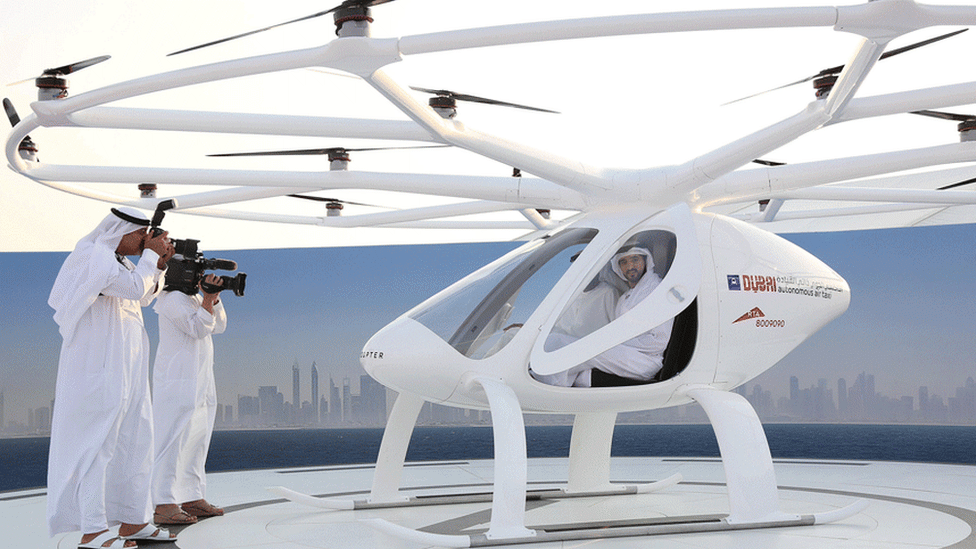
The Safety: Redundancy is Key Is it safe? Safer than a helicopter. A helicopter has a “Single Point of Failure.” If the main rotor breaks, you fall (or autorotate if you’re lucky). eVTOLs have Redundancy. An aircraft like the Volocopter has 18 rotors. If one, two, or even three motors fail, the aircraft can still land safely. There are no single points of failure. Plus, most models come equipped with a ballistic parachute that can lower the entire plane to the ground in a catastrophic emergency.
The Regulatory Hurdle: Waiting for the FAA The technology is ready. The planes are flying in test zones right now. The bottleneck is the law. The Federal Aviation Administration (FAA) in the US and EASA in Europe are currently writing the rulebook. Certification is a slow, painful process because the standard for aviation safety is incredibly high (10^-9 failure rate). However, target dates for commercial operations are set for 2025-2026, likely starting with fixed routes in cities like Dubai, Paris, and Los Angeles.
Conclusion We are on the verge of the biggest shift in urban mobility since the invention of the subway. For the last century, we tried to solve traffic by building more lanes and digging tunnels. We forgot that we have an infinite amount of space above our heads. The roads of the future aren’t made of asphalt; they are made of air.