
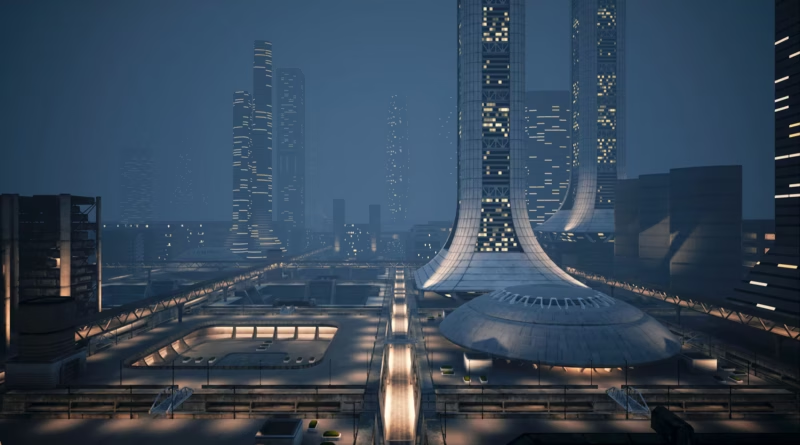
Utopia or Dystopian Cage? Inside “The Line”: Saudi Arabia’s $1 Trillion Horizontal Skyscraper (2025 Construction Update)
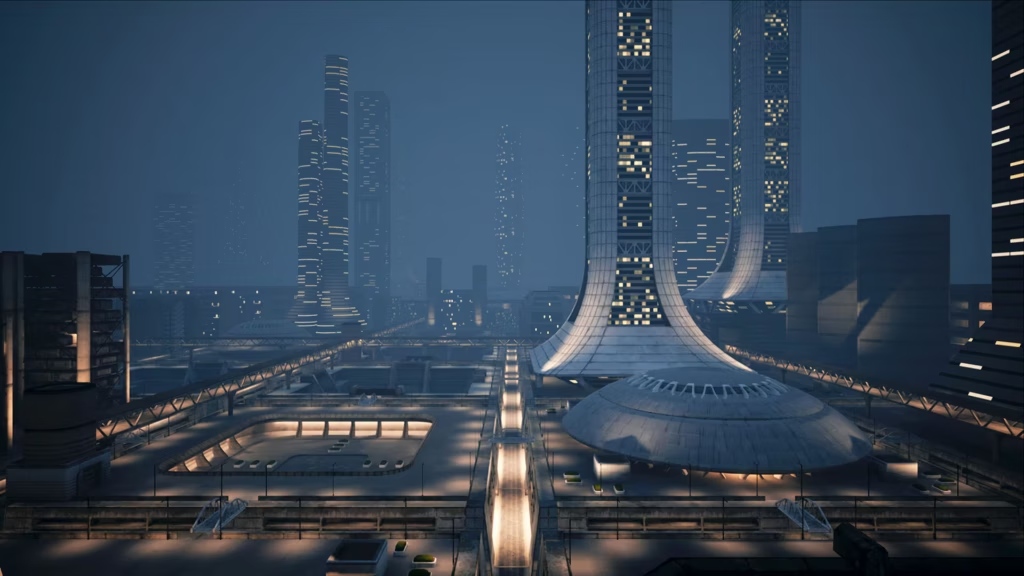
(Intro) Construction has begun on the most ambitious, expensive, and controversial architectural project in human history. If you look at the latest satellite images of the Tabuk province in Saudi Arabia, you won’t see a sprawling suburb or a grid of roads. You will see a massive, straight scar cutting through the desert and mountains.
It is called The Line. Part of the massive NEOM initiative, this isn’t just a new city; it is a rejection of everything we know about urban planning. Forget cars. Forget streets. Forget spreading out. The Line is a single building that is 170 kilometers long, 200 meters wide, and 500 meters tall. To put that in perspective: It is taller than the Empire State Building, but stretches for the distance of London to Birmingham. It is a “Horizontal Skyscraper” designed to house 9 million people.
The Specs: The “Mirror Line” The sheer engineering audacity is hard to comprehend. The structure consists of two parallel wall-like skyscrapers encased in mirrored glass, reflecting the desert landscape. Inside these walls lies a sci-fi civilization. The concept is called “Zero Gravity Urbanism.” Instead of living on a 2D plane (ground level), the city is layered vertically. Parks, schools, homes, and offices are stacked on top of each other. The goal is that everything you need for daily life is within a 5-minute walk—not horizontally, but three-dimensionally, using high-speed elevators and skybridges.
No Cars, Just Hyper-Speed The most radical feature of The Line is the total absence of cars. There are no roads, no traffic lights, and no exhaust fumes. So, how do you travel 170km? Buried deep underground is “The Spine”—a massive transport infrastructure layer. It promises a high-speed rail system capable of traveling from one end of the city to the other in 20 minutes. Mathematically, this requires trains to travel at speeds exceeding 500 km/h (310 mph). While current maglev technology creates a theoretical possibility, implementing it safely in a populated zone is an engineering marvel in itself.
The Green Paradox: Savior or Destroyer? The marketing pitch is beautiful: 100% Renewable Energy. No carbon footprint. Nature preserved outside the walls. However, architects and ecologists are divided.
- The Proponents: They argue that by condensing 9 million people into a small footprint (only 34 square km), we stop destroying nature with urban sprawl. It is the ultimate efficiency.
- The Critics: They point to the “Embodied Carbon” of the construction. Building two 170km-long walls of steel, concrete, and glass requires a monumental amount of energy.
- The Mirror Problem: Ornithologists warn that a 500-meter tall mirror wall cutting across the desert could be a death trap for millions of migratory birds who won’t “see” the building.
A Smart City… or a Surveillance Cage? For the tech geek, The Line is both a dream and a nightmare. NEOM is designed to be the smartest city on Earth. Every interaction, from trash collection to entry doors, is powered by Artificial Intelligence. This brings us back to the privacy concerns we discussed in our [Smart Home Privacy] guide—but on a city-wide scale.
To make the city efficient, the AI needs data. Your data. Where you go, what you buy, who you meet. Critics argue this could become a “Gilded Cage”—a luxurious prison where life is perfect, but privacy is non-existent. In a city where the government controls the oxygen, the water, and the digital exits, how much freedom does a resident truly have?
2025 Construction Status: It’s Actually Happening For years, people called this “Vaporware” (software/hardware that is announced but never released). They said it was just a CGI render to attract investors. But in late 2025, the drone footage proves them wrong. The “trench” is being dug. Massive piling rigs are driving foundations into the sand. The initial modules are taking shape. Saudi Arabia is spending billions of dollars a month to prove that this isn’t a fantasy.
Conclusion The Line is the Pyramids of the Digital Age. Whether it becomes a utopian paradise that solves overpopulation or a dystopian failure that stands as a ruin in the desert, one thing is clear: Humanity is done with boring suburbs. The future of cities is vertical, linear, and radically different. And for better or worse, the experiment has begun.
“Read Also: Why Time Feels Faster As You Age (It’s Not Just You)“