
The Great Silence: Why the Internet Feels “Empty” in 2025 (Even Though Traffic is at an All-Time High)
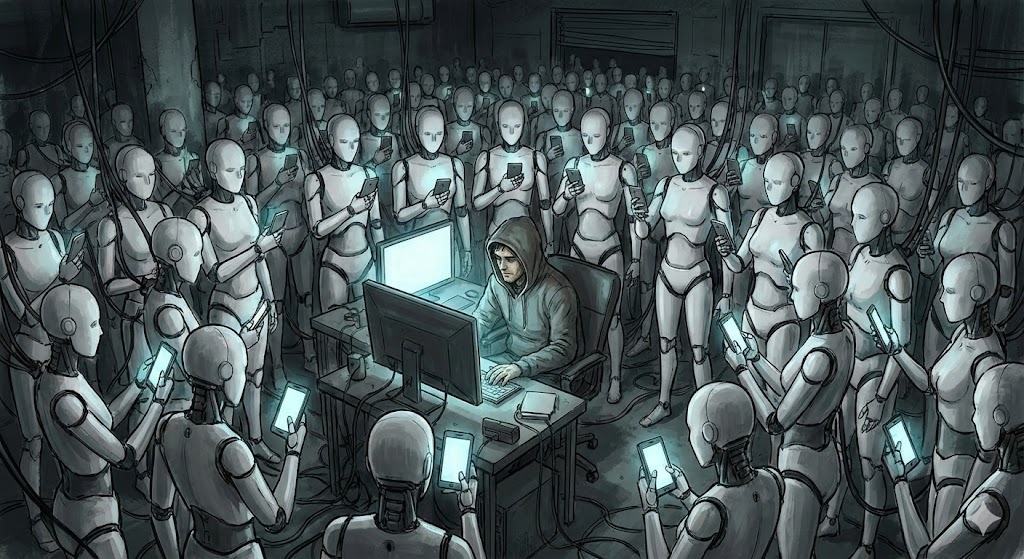
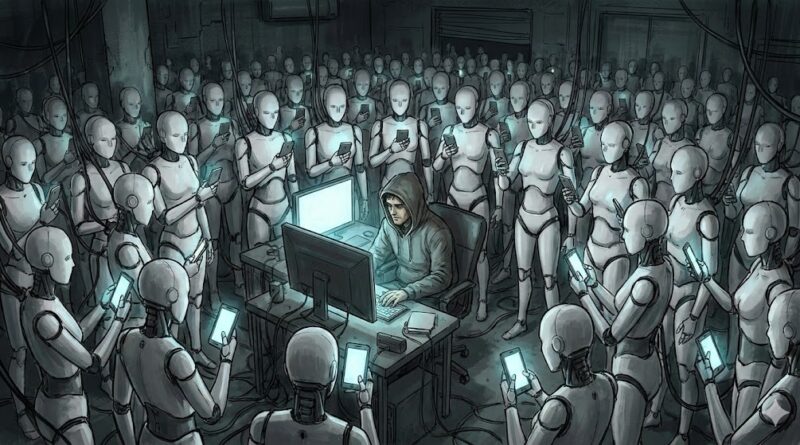
Man surrounded by AI bots on social media concept art 2025
If you have been online since the early 2000s—the era of forums, personal blogs, and chaotic IRC chats—you might have noticed a strange, unsettling feeling lately. A sense of… Déjà vu.
You scroll through X (formerly Twitter), Threads, or the comment section of a viral YouTube video. The engagement numbers are massive. We are talking about millions of likes, hundreds of thousands of replies. But if you stop and actually read them, the “soul” is missing. The comments look oddly repetitive. The phrasing feels synthetic. The outrage feels calculated.
Welcome to the reality of late 2025. We are living through what computer scientists warned us about five years ago: The Dead Internet Theory is no longer a fringe conspiracy theory. It is our daily, statistical reality.
The Bot-to-Bot Economy: By the Numbers According to a shocking Q3 2025 report by CyberSentinel, nearly 74% of global web traffic is now non-human. But don’t mistake these for the “clunky” spam bots of 2010 that sold cheap sunglasses. These are sophisticated Large Language Model (LLM) Agents.
We have reached a bizarre point in the digital economy where an AI writes a news article, another AI summarizes it for social media, and thousands of “User Bots” leave AI-generated comments like “Great insight!” or “This is the future!” to boost the algorithm. Why? Because engagement equals money. Advertisers are paying to show ads to an audience of robots. Real humans are becoming spectators in an empty stadium, watching robots cheer for other robots.
The Ouroboros Effect: AI Eating Itself This phenomenon is leading to a technical catastrophe known as “Model Collapse.” AI models need human data to learn. But because the internet is now flooded with AI-generated content (or “AI Slop”), newer models are being trained on data created by older models.
It’s like making a photocopy of a photocopy of a photocopy. Eventually, the quality degrades into noise. In 2025, we are seeing search engines struggle to find “human” answers. You ask for a recipe, and you get a generic, SEO-optimized block of text that no human ever wrote (and likely no human ever cooked). This degradation of information is what makes the internet feel “dead” or useless, forcing users to append “reddit” to their Google searches just to find a real person’s opinion.
The “Dark Forest” Retreat Where did all the real people go? They didn’t leave the internet; they just went underground. Sociologists call this the “Dark Forest Theory” of the web, named after Liu Cixin’s sci-fi novel. In a forest filled with predators (algorithms, trolls, and bots), the smartest survival strategy is to stay quiet.
Public social media has become too noisy, too dangerous, and too synthetic. So, the true “Geek Culture” has migrated back to:
- Closed Discord Servers: Where you need an invite to enter.
- Encrypted Telegram/Signal Groups: Where conversation is private.
- Private Decentralized Nodes: Small, federated communities (like Mastodon instances) that block the outside world.
If you feel like the public internet is dying, it’s because the real party has moved to a VIP room where the AI crawlers aren’t invited.
The Rise of “Proof of Personhood” This crisis has birthed a new verification economy. In the past, a “Blue Checkmark” was a status symbol for celebrities. In 2025, it is a necessity for survival. Platforms are increasingly demanding biometric verification (like WorldID or Passkeys) just to prove you have a pulse.
This is why websites like Daily Dejavu and curated niche forums are becoming valuable again. Readers are tired of infinite, perfect AI content. They crave Human Error. They want to read a typo. They want to hear a controversial, biased, emotional opinion—because that proves a human wrote it.
The Economic Impact on Influencers The “Dead Internet” is also killing the traditional influencer. Brands are realizing that paying an influencer with 1 million followers is worthless if 900,000 of them are “Engagement Farming Bots.” We are seeing a shift towards “Micro-Influencers” with tiny but verifiable audiences. The metric for success is no longer Reach, but Resonance.
Conclusion The internet isn’t dead, but the “Old Web”—the loud town square where everyone shouted and everyone listened—is officially over. We are entering the era of the “Cozy Web.” It is smaller, quieter, harder to find, but infinitely more real.
So, if you are reading this article, and you understood the nuance, the irony, and the fear behind these words: Hello. You are the resistance. You are the signal in the noise.
“Read Also: The Great Silence: Why the Internet Feels “Empty” in 2025 (Even Though Traffic is at an All-Time High)“