
The Return of the Tinkerer: Why 2025 is the Golden Age of Modular Tech (and the End of Sealed Batteries)
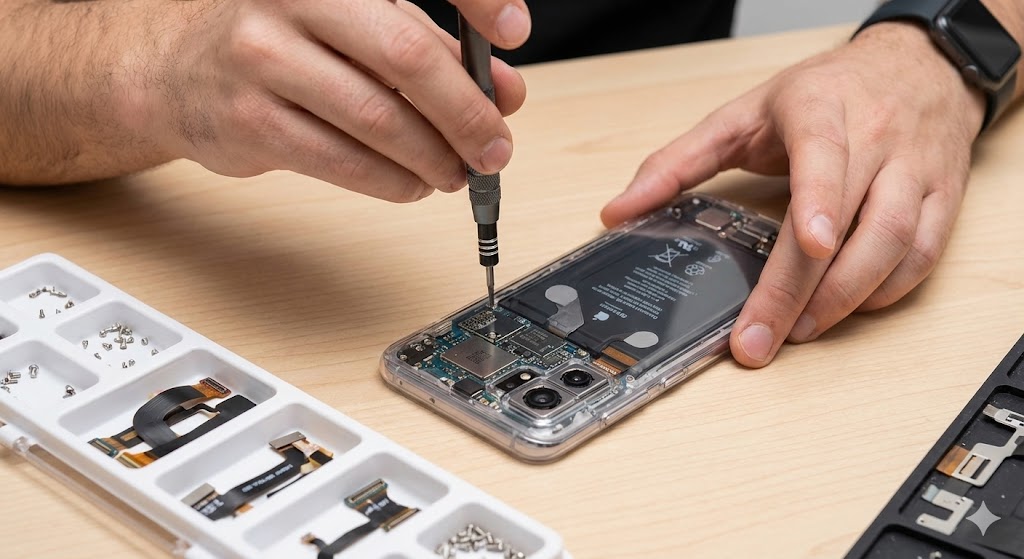
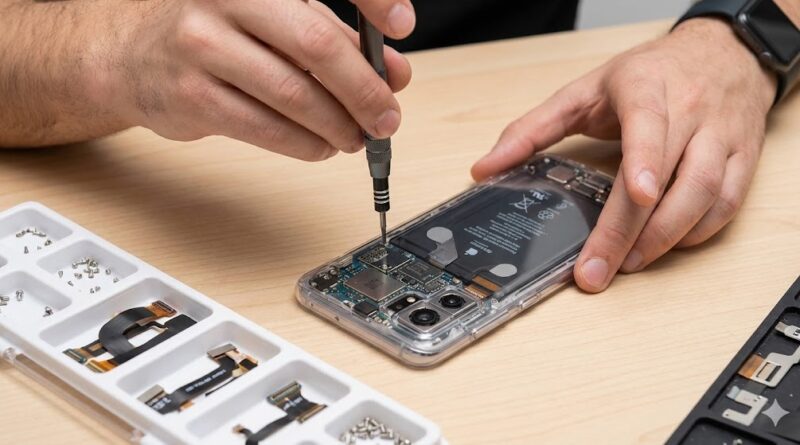
Person repairing modular transparent smartphone with tools 2025
For the last decade, the definition of “Premium” in the tech world meant one thing: Sealed. Major manufacturers like Apple, Samsung, and Google treated their devices like sacred monoliths. They glued their phones shut with industrial-strength adhesive, soldered RAM chips directly onto motherboards, and used proprietary screws that no normal screwdriver could turn.
The message to the user was clear: “You are a toddler. You are allowed to touch the screen, but you are never allowed to see what is inside.” If your battery died after two years? Buy a new $1,000 phone. If your charging port got loose? Pay a “Genius” $300 to fix a $5 part.
But as we close out 2025, the pendulum has swung back violently. Thanks to the strict enforcement of the EU Right to Repair Act (2024) and a massive cultural shift among Gen Z and Alphas, the “Sealed Era” is officially dead. The screws are back, and they are beautiful.
The Regulatory Hammer: How Europe Changed the World We cannot talk about this trend without crediting the legislation that forced it. The European Union’s mandate requiring all portable electronics to have user-replaceable batteries by 2027 sent shockwaves through Silicon Valley.
Manufacturers realized they couldn’t design two separate phones (one for Europe, one for the world). So, in 2025, we saw the global shift. The glue vanished. Pull-tabs and standard Phillips-head screws returned. For the first time in 15 years, you can now swap the battery of a flagship smartphone in under 60 seconds without a heat gun or a suction cup. It’s not just a feature; it’s the law.
The Aesthetic of Exposed Screws Functionality has birthed a new aesthetic. Look at the best-selling gadgets of Q4 2025. The Framework Phone and the Fairphone 6 aren’t hiding their screws; they are highlighting them. Transparency is the new black. Clear plastic backplates—reminiscent of the iconic 90s GameBoy Color or the Nothing Phone era—are everywhere.
Geeks are no longer impressed by how impossibly thin a device is. We are impressed by how fast we can tear it down. The ultimate “flex” in a coffee shop today isn’t having the newest shiny iPhone; it’s pulling out a screwdriver set and hot-swapping your camera module from a standard 50MP lens to a telephoto lens while waiting for your latte. The “Cyberpunk” look isn’t just a skin anymore; it’s structural.
3D Printing: Hardware is the New Software The modular revolution goes beyond just batteries and screens. The rise of affordable, high-resolution home 3D printing has turned users into manufacturers. Companies like Framework have released the CAD files (Schematics) of their devices to the public. This was unthinkable five years ago.
Now, if you want a phone case with a built-in kickstand, a mount for your bicycle, or a thicker grip for gaming, you don’t buy it from Amazon. You download the file from community repositories like Printables or Thangs, and you print it at home. Hardware has become like software: open-source, community-driven, and infinitely customizable. We are seeing a flood of “Franken-phones” on Reddit, where users have modified their devices to include physical keyboards, extended batteries, or even Geiger counters.
The Economic Necessity: The “Ship of Theseus” Let’s be honest: economy plays a huge role. The average price of a flagship phone in 2025 has touched $1,600. In this economy, nobody wants to replace a laptop or phone every two years just because the battery holds less charge or the USB-C port is wobbly.
Modular tech allows for the “Ship of Theseus” approach. You keep the same phone chassis for five or six years.
- Year 2: You swap the battery ($30).
- Year 3: You upgrade the Camera Module to the latest sensor ($80).
- Year 4: You replace the scratched screen ($100).
Over 5 years, you spend significantly less than buying three new phones, and you generate 80% less e-waste. It is cheaper, it is smarter, and it is the only sustainable path forward for the planet.
The Death of Planned Obsolescence? This trend terrifies legacy tech giants because it breaks their business model of “Planned Obsolescence.” They can no longer throttle your phone’s performance to force an upgrade. However, smart companies are pivoting. They are realizing there is money to be made in selling modules and parts rather than whole devices. An ecosystem of upgrades is more profitable in the long run than a one-time sale.
Conclusion We have finally remembered a core truth of technology: If you can’t open it, you don’t own it. For too long, we were merely “renting” our devices from manufacturers who dictated how we used them. In 2025, the user has reclaimed ownership.
The Tinkerer is back. So, put away the heat gun, the glue dissolver, and the fear of voiding your warranty. Pick up your screwdriver. It’s time to build.