The Day the Music Died? How an AI-Generated Song Just Hit Global #1 (And Why Musicians Are Panicking)
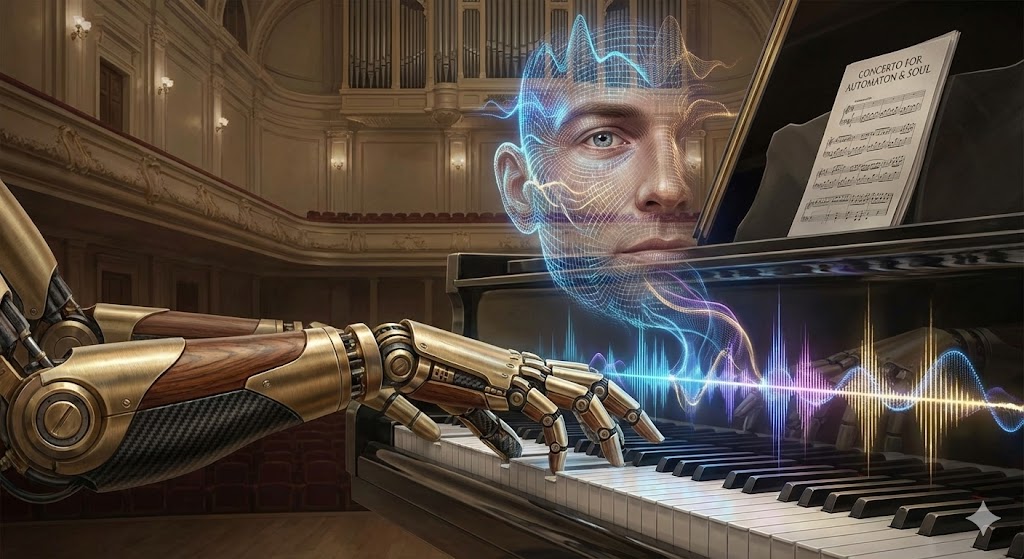
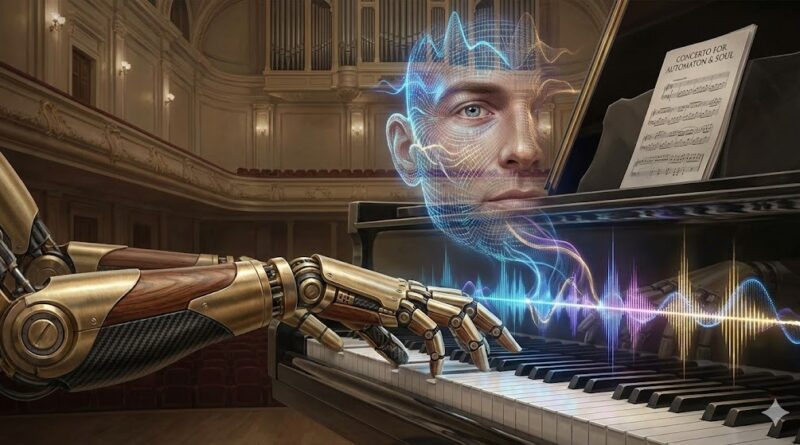
It finally happened. December 2025 will go down in history books, but not for a reason music purists will celebrate. This month will be remembered as the moment the Billboard Hot 100 was conquered not by Taylor Swift, not by a BTS solo project, and not by a viral TikTok star. The number one spot belongs to “Project Echo”—an anonymous artist that, strictly speaking, does not exist.
The song, titled “Synthetic Tears,” is an earworm. It features a haunting falsetto, complex chord progressions, and lyrics about loneliness that resonated with millions of Gen Z listeners. But last week, the curtain was pulled back. Project Echo was revealed to be a stress-test experiment for Google’s latest generative audio model, DeepMelody Pro.
The song was entirely composed, written, arranged, and sung by code. No human vocal cords vibrated; no human fingers touched a guitar string. The era of human dominance in pop music hasn’t just been challenged; it might have officially ended.
The “Turing Test” of Audio: How They Fooled Us For years, AI music was a gimmick. In 2023, we had “SpongeBob singing Gangsta’s Paradise” or low-fidelity lofi beats that sounded robotic and hollow. But 2025 changed everything with the introduction of “Emotional Modeling” algorithms.
Unlike previous models that simply predicted the next note based on mathematical probability, DeepMelody Pro was trained on a dataset of “psychological triggers.” It understands that a minor seventh chord followed by a sudden silence creates tension. It knows that a slight “crack” in the voice at the end of a sentence simulates vulnerability.
“Synthetic Tears” passed the ultimate audio Turing Test. Before the reveal, music critics described the track as “raw,” “soulful,” and “painfully human.” Millions streamed it on Spotify thinking they were supporting a breakout indie artist from a garage in Seattle. When the truth came out, the internet broke. Fans felt betrayed, claiming they had been “emotionally manipulated” by a machine, while tech enthusiasts celebrated the milestone as the singularity of art.
The Technology: From MIDI to Raw Waveforms To understand the gravity of this, we need to look under the hood. Old AI music tools generated MIDI files (digital sheet music) that then had to be played by virtual instruments. It sounded clean but fake.
DeepMelody Pro works differently. It generates Raw Waveforms directly. It constructs the sound wave pixel-by-pixel (or sample-by-sample). This allows it to replicate the “imperfections” that make music sound real: the sound of a singer inhaling before a chorus, the squeak of fingers sliding on a guitar string, or the slight buzz of a vintage amplifier. It was these calculated imperfections that fooled the world. The AI learned that to sound human, it had to make mistakes.
The “Certified Organic” Audio Movement The cultural backlash has been swift, brutal, and fascinating. In response to Project Echo, a new counter-culture is emerging among audiophiles and purists: the “Biological Audio” movement.
Just as consumers pay a premium for “Organic” vegetables or “Handmade” furniture, human artists are beginning to brand their music with “100% Human Made” verification stickers on streaming platforms. We are seeing a resurgence of “Live Studio Sessions” where artists record in one take on video, just to prove they are actually playing the instruments. The prediction for 2026? Imperfection will become a luxury. Auto-tune might disappear, replaced by raw, slightly off-key vocals that prove biological origin.
Democratization vs. Devaluation: The Economic Crisis The debate is currently tearing the creative community apart. On one side, techno-optimists argue this is the ultimate Democratization. A kid in a basement in Jakarta with no money for expensive violins or studio time can now compose a Hollywood-level symphony using just a prompt. It lowers the barrier to entry to zero.
On the other side, session musicians, background singers, and jingle writers are seeing their livelihoods vanish overnight. The economics are undeniable:
- Human Cost: Hiring a composer for a 30-second commercial jingle costs $5,000 and takes 3 days.
- AI Cost: Generating a jingle with DeepMelody Pro costs $0.50 and takes 10 seconds.
If you are an advertising agency, the choice is purely mathematical. This threatens to wipe out the “Middle Class” of musicians—the people who don’t fill stadiums but make a living doing background scores and commercials.
The Copyright Nightmare The legal system is woefully unprepared for this. Universal Music Group (UMG) and other giants are currently in emergency litigation. The core question: Who owns “Synthetic Tears”?
- Does Google own it because they built the tool?
- Does the user who typed the prompt own it?
- Or is it Public Domain because “machines cannot hold copyright”?
Furthermore, DeepMelody Pro was trained on millions of copyrighted songs. Is this “Fair Use” (like a human student listening to the Beatles to learn rock) or is it “Data Theft” on a massive scale? The lawsuits filed in 2026 will likely determine the future of intellectual property for the next century.
Conclusion We are standing at the precipice of a new reality. Music is no longer just about human expression; it is about data processing. The question for 2026 isn’t “Can AI make good music?” We know it can. The question is: “Will we still care about human music when the synthetic version is cheaper, faster, and statistically catchier?”
Perhaps we will. Perhaps the story behind the artist—their struggles, their heartbreak, their humanity—will matter more than the sound itself. But for now, Project Echo sits at #1, and the silence in the recording studios is deafening.