
Flat Screens Are Dead: Why 2025 Is the Year Consumer Holograms Finally Became Reality
For almost a century, our window to the digital world has been a flat, 2D rectangle. Whether it was the bulky cathode-ray tube (CRT) TVs of the 1990s or the razor-thin, paper-like OLED panels of today, the fundamental experience has remained unchanged: we are staring at a surface. We are outsiders looking in.
But as 2025 draws to a close, the “Age of the Flat Screen” is gasping its last breath. The technology sector is witnessing a paradigm shift comparable to the move from black-and-white to color. The release of the first truly affordable Light Field Displays from pioneers like Sony, Looking Glass Factory, and Leia Inc. has moved holograms from the realm of Star Wars science fiction directly into our living rooms.
And the best part? You don’t need goofy red-and-blue 3D glasses, and you certainly don’t need a bulky VR headset strapped to your face. Here is why the flat screen is about to become a relic of the past.
Beyond the “Screen Door”: How It Actually Works To understand why 2025 is the tipping point, we must first understand why previous attempts at 3D failed. Remember 3D TVs in 2012? They failed because they relied on a trick called “Stereoscopy”—showing two slightly different flat images to create a fake sense of depth. Your brain eventually realized it was being tricked, leading to headaches and nausea.
The magic behind these 2025 devices isn’t smoke and mirrors; it’s advanced Photonics and Light Field Technology. Unlike old 3D, a Light Field display projects millions of light rays at different angles simultaneously. It recreates the way light bounces off real-world objects.
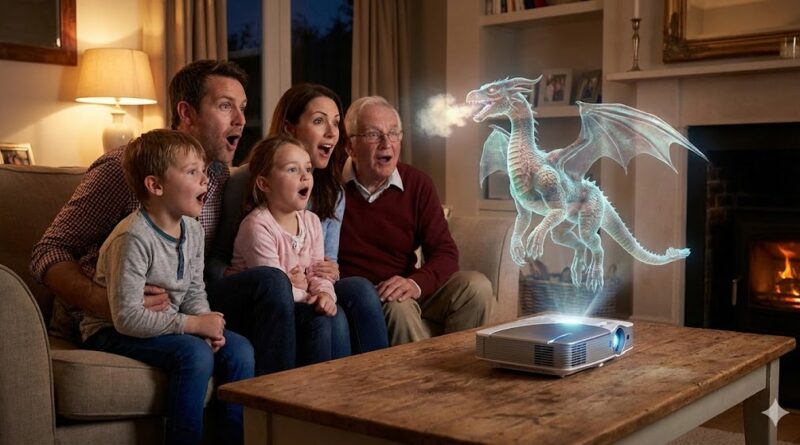
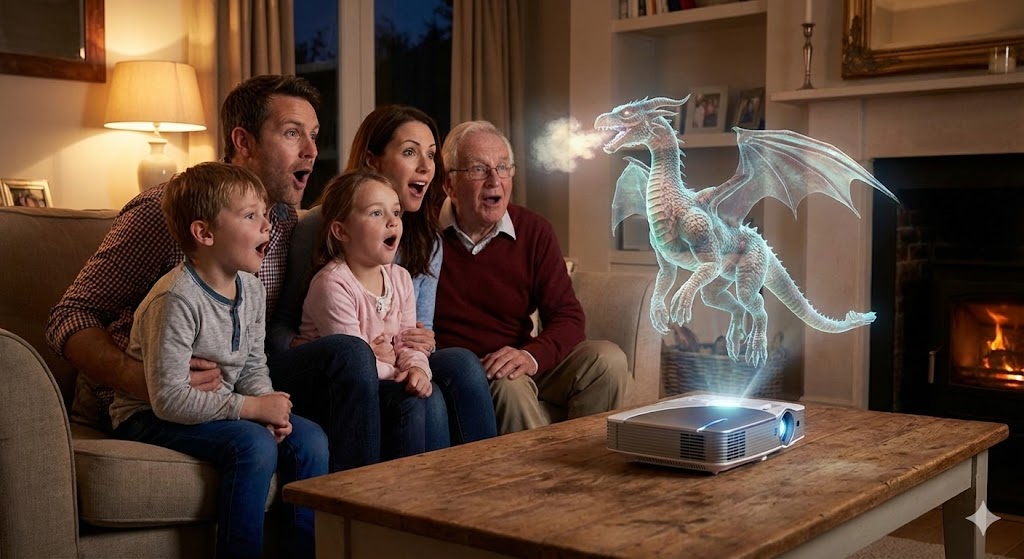
The End of the “Vergence-Accommodation Conflict” This is the technical breakthrough. In VR or old 3D, your eyes focus on the screen (Accommodation) but your brain thinks the object is far away (Vergence). This mismatch causes eye strain. Light Field displays solve this. If a holographic dragon is displayed “floating” 10 inches in front of the screen, your eyes actually focus on that empty space 10 inches away. The result is a visceral sense of presence. The digital object feels real, solid, and occupies physical volume. It feels like you could reach out and grab it.
The Hardware Ecosystem: Who is Leading the Charge? In late 2025, the market is no longer just prototypes. Real products are on the shelves.
- Looking Glass Go & Pro: The market leaders have refined their “block” design. Their displays look like thick pieces of glass where digital life lives inside. They have become the standard for digital artists and memory capture.
- Sony Spatial Reality Display (Gen 3): Sony has perfected eye-tracking technology. Using high-speed cameras built into the bezel, the display tracks your pupil position in real-time, adjusting the micro-lenses instantly so the 3D image looks perfect from your exact perspective, even as you move your head around.
- Acer SpatialLabs: Integrating this tech into laptops, making it accessible for creators on the go.
A Game-Changer for Geeks (Literally) While movies are cool, gaming is the killer app for holograms. We tested the newly patched Civilization VII on a 32-inch Light Field monitor, and it was a revelation.
The map isn’t just on the screen; it’s a miniature, living diorama floating above your desk. Mountains cast real shadows based on your room’s lighting. You can lean in to inspect tiny units or look around a skyscraper to see what’s hiding behind it. The “screen border” disappears mentally, and the game world bleeds into your physical reality.
Imagine playing an RPG where the inventory menu floats in the air closer to you, while the character stands further back. It offers the immersion of Virtual Reality (VR) without the isolation of being cut off from the real world. You can still see your coffee cup; you can still talk to your friends, but the game is sharing your physical space.
The Hidden Cost: Computing Power However, there is a catch that manufacturers don’t put on the box. Driving a Light Field display is computationally expensive. A standard 4K monitor requires your GPU to render roughly 8 million pixels. A Light Field display requires rendering 40 to 100 views of the same scene simultaneously to create that holographic effect.
This explains the sudden demand for NVIDIA’s RTX 50-series cards in late 2025. Without AI upscaling technologies like DLSS 4.0 and frame generation, these holographic displays would bring even the most powerful PC to its knees. The “Hologram Era” is inextricably linked to the “AI Era.”
Beyond Entertainment: Medicine and Design If you think this is just a toy for gamers, think again. The professional implications are staggering.
- Medical: Surgeons are using these displays to view MRI scans in true volumetric 3D before making a cut. They can rotate a floating heart to see the blockage from behind, something impossible on a 2D monitor.
- Architecture: Architects no longer need to build physical scale models. They project the holographic building on the conference table, allowing clients to peer into windows and visualize the structure in the real world.
The “Early Adopter” Tax: Is It Worth It? Of course, this is bleeding-edge tech. The entry price for a decent consumer-grade holographic monitor is still hovering around $3,000 to $4,000—roughly the same price trajectory as the first 4K Plasma TVs a decade ago.
There are limitations. The “Field of View” (FOV) is still restricted; if you stand too far to the side (usually beyond 60 degrees), the illusion breaks, and the image clips. The brightness is also lower than a standard HDR OLED panel.
But for the hardcore geek enthusiast, the price is irrelevant. We are paying for the “Wow Factor.” We are paying to live in the future today. This isn’t just a slightly better TV with deeper blacks; it is a completely new medium of consumption.
Conclusion We are witnessing the biggest shift in display technology since the invention of color television. The screen is no longer just a window you look through; it is a stage where digital reality plays out.
The flat screen had a good run. It served us well for 100 years. But as we head into 2026, depth is the new standard. If you are still planning to spend thousands on a flat OLED panel next year, you might want to reconsider. You are buying yesterday’s technology. The future is volumetric, and it is finally here.