
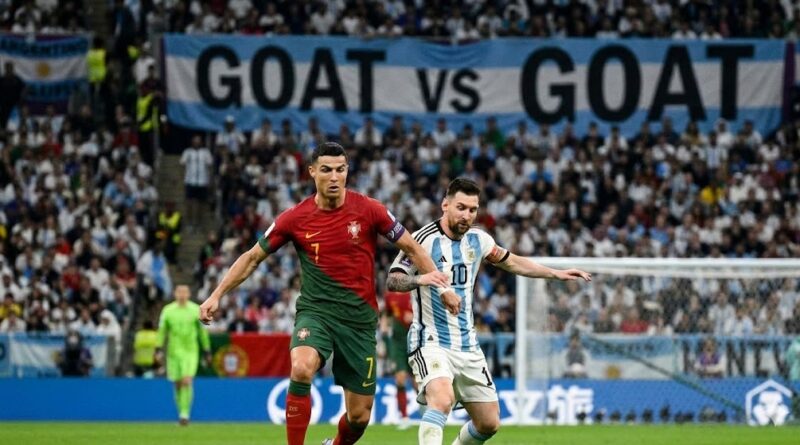
The Final Verdict: Messi vs. Ronaldo in 2025 – Analyzing the End of the GOAT Era
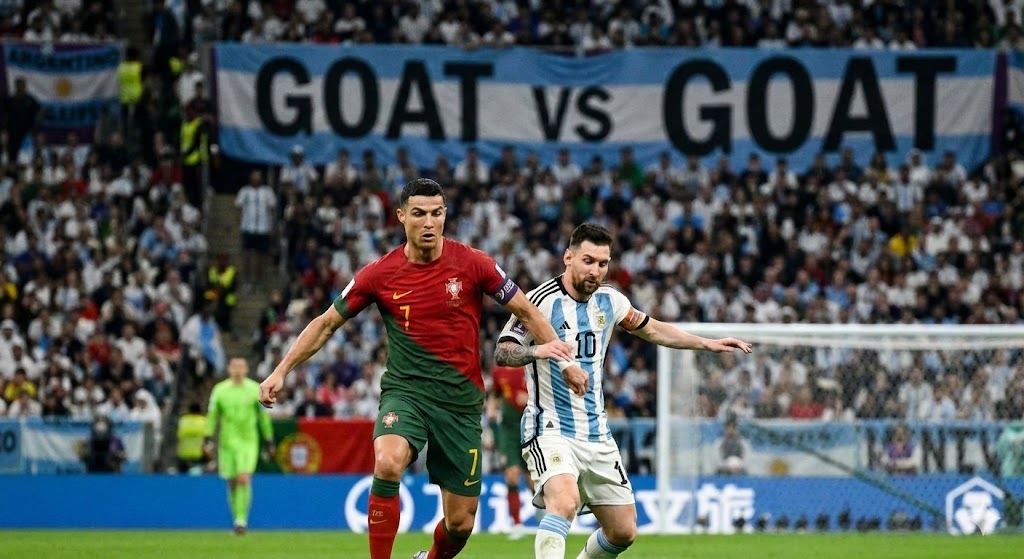
LONDON — It is the debate that broke the internet. It divided families, fueled bar fights from Buenos Aires to Lisbon, and generated more social media engagement than any geopolitical conflict in the 21st century.
Lionel Andrés Messi vs. Cristiano Ronaldo dos Santos Aveiro. The Flea vs. The Robot. The Artist vs. The Machine.
As we stand here in the dying days of 2025, the dust is finally beginning to settle. Ronaldo, approaching his 41st birthday, and Messi, now 38, are playing out the final, lucrative chapters of their careers in Saudi Arabia and the United States, respectively. The European nights that defined their prime are now distant memories, replaced by the desert heat of Riyadh and the humid nights of Miami.
But the question remains, burning brighter than ever in the retrospective light of history: Who was the greatest?
At Daily Dejavu, we don’t just look at the goals. We look at the data, the cultural shifting, and the psychological warfare that defined this two-decade duality. This is the definitive analysis of the Messi-Ronaldo era.
Part I: The Statistical Anomaly
To understand the debate, we must first acknowledge the absurdity of the numbers. Before this duo emerged, scoring 30 goals in a season was considered “world-class.” Messi and Ronaldo normalized scoring 50, 60, even 70 goals a year. They broke the scale.
The Machine: Cristiano Ronaldo
Ronaldo’s legacy is built on the sheer force of will. He is the greatest athlete the sport has ever seen. Not the greatest footballer, perhaps, but the greatest athlete. His game evolved from a flashy winger with too many step-overs at Manchester United to the most lethal predatory striker in history at Real Madrid.
By 2025, his official goal count has surpassed 900—a number that seems fictitious. He owns the Champions League. When the lights were brightest, Ronaldo was inevitable. His jumping reach, his ambidexterity, and his penalty-box awareness turned him into a biological algorithm designed to score.
- The Defining Stat: Ronaldo is the top scorer in the history of professional football.
- The Argument: If you built a footballer in a laboratory to save your life, you would build Cristiano Ronaldo.
The Magician: Lionel Messi
If Ronaldo is physics, Messi is metaphysics. He didn’t just play the game; he completed it. Messi’s numbers are terrifying not because of the volume, but because of the efficiency. He matched Ronaldo’s goal-scoring output while simultaneously being the world’s best playmaker.
The “Eye Test” has always favored the Argentine. Ronaldo forces the game to bend to his will; Messi waits for the game to flow through him. His low center of gravity, his vision, and that impossible left foot allowed him to operate in spaces that shouldn’t exist.
- The Defining Stat: The most Ballon d’Or awards in history (8).
- The Argument: Ronaldo is the best goalscorer, but Messi is the best player.
Part II: The 2022 Trump Card
For years, the debate was deadlocked. Ronaldo had more Champions Leagues; Messi had more domestic titles. Ronaldo had the international trophy first (Euro 2016); Messi struggled with Argentina.
Then came Qatar 2022.
The 2022 FIFA World Cup changed the calculus of the GOAT debate forever. Messi’s performance in Qatar was not just a sporting achievement; it was a cinematic climax. Dragging an imperfect Argentina side to glory, scoring in every knockout round, and lifting the trophy that eluded him for so long provided the “narrative closure” that Ronaldo lacks.
In 2025, the shadow of that World Cup still looms large. For the “Messi Camp,” the debate ended the moment he kissed the golden trophy in Lusail. It was the checkmate. Ronaldo’s tearful exit against Morocco in the same tournament served as a brutal, contrasting juxtaposition.
However, the “Ronaldo Camp” argues that one tournament—a knockout tournament decided by penalties—cannot erase 20 years of dominance. They point to the Champions League “Three-Peat” with Real Madrid as a feat of consistency that a 7-game World Cup cannot match.
Part III: The Geopolitical Split (Saudi vs. USA)
The post-2023 era saw the rivalry shift from the pitch to the boardroom. Their choices of final destinations were starkly different, representing the two new power centers of global football.
The Saudi Pioneer
Ronaldo’s move to Al Nassr was ridiculed at first, but history will view it as a watershed moment. He was the first domino. Because Ronaldo went, Benzema went. Neymar went. Mane went. Ronaldo single-handedly legitimized the Saudi Pro League, turning a retirement home into a genuine disruptive force in the market.
In 2025, we see the Saudi League broadcasting to 150 countries. That is the “Ronaldo Effect.” His brand is expansionist, aggressive, and empire-building.
The American Dream
Messi’s move to Inter Miami was different. It was a lifestyle choice, a branding alignment with Apple and Adidas, and a mission to conquer the final frontier: North America. Messi didn’t try to build a league; he tried to sell a vibe. The “Messi Mania” in the US leading up to the 2026 World Cup has arguably done more for soccer’s popularity in America than Pele ever did.
While Ronaldo went for “Empire,” Messi went for “Legacy.”
Part IV: The Toxic Algorithm
We cannot discuss Messi vs. Ronaldo without discussing Us. The fans. The social media warriors.
This rivalry coincided perfectly with the rise of Facebook, Twitter (X), and Instagram. The algorithms fed on conflict. You weren’t allowed to like both. To praise Messi, you had to insult Ronaldo. To love Ronaldo, you had to call Messi a “fraud.”
- “Pessi” and “Penaldo”: The childish nicknames that dominate Twitter threads even in 2025 are symptoms of a tribalism that transcended sport.
- The Fanboys: Ronaldo’s fanbase (The “CR7 Army”) admires the hustle, the alpha mentality, the self-made billionaire aesthetic. Messi’s fanbase (The “Messi FC”) worships the talent, the humility, the “pure football.”
This digital war forced the players into caricatures. Ronaldo became the villain; Messi became the saint. The reality, of course, is far more nuanced. Ronaldo does incredible charity work; Messi can be ruthless and petulant on the pitch. But the internet doesn’t do nuance.
Part V: The Science of Longevity
How did they last this long? In 2025, playing at an elite level at 38 and 40 is biologically absurd.
Ronaldo’s Body: Cristiano turned his body into a temple. Ice baths at 3 AM, no sugar, strictly calculated sleep cycles. He reinvented his game three times: from a trickster winger, to a powerful number 9, to a pure poacher. He refused to accept the dying of the light. His longevity is a triumph of discipline.
Messi’s Brain: Leo preserved his energy. He famously “walks” more than any other player on the pitch. He scans. He waits. By conserving energy when the ball is away, he unleashes explosive bursts when it matters. As his speed declined, his passing range improved. He dropped deeper, becoming a quarterback. His longevity is a triumph of intelligence.
Part VI: The Verdict in 2025
So, who won?
If you value Art, the answer is Lionel Messi. He provided moments of beauty that defy logic. He completed football by winning everything there is to win. The World Cup 2022 is the golden stamp that likely secures his place as the singular “Greatest” in the eyes of purists and historians.
If you value Drive, the answer is Cristiano Ronaldo. He is the ultimate inspiration. The kid from Madeira who had heart surgery, no money, and willed himself to be better than the genius. He proved that hard work can rival talent. He conquered England, Spain, and Italy.
The Daily Dejavu Conclusion: We shouldn’t be asking who is better. We should be terrified of the void they will leave behind. Look at the next generation: Mbappe, Haaland, Bellingham, Yamal. They are incredible. But will they score 50 goals a season for 15 years straight? Will they split 13 Ballon d’Ors between them? Unlikely.
We didn’t watch a rivalry. We watched an anomaly. A glitch in the matrix where two of the top five players in history happened to be born two years apart.
In 2025, as the curtain falls, put down the “Pessi” and “Penaldo” tweets. Just watch them. Watch Ronaldo leap one last time. Watch Messi dribble one last time.
Because when they are gone, we will realize that the debate didn’t matter. The privilege of witnessing it did.
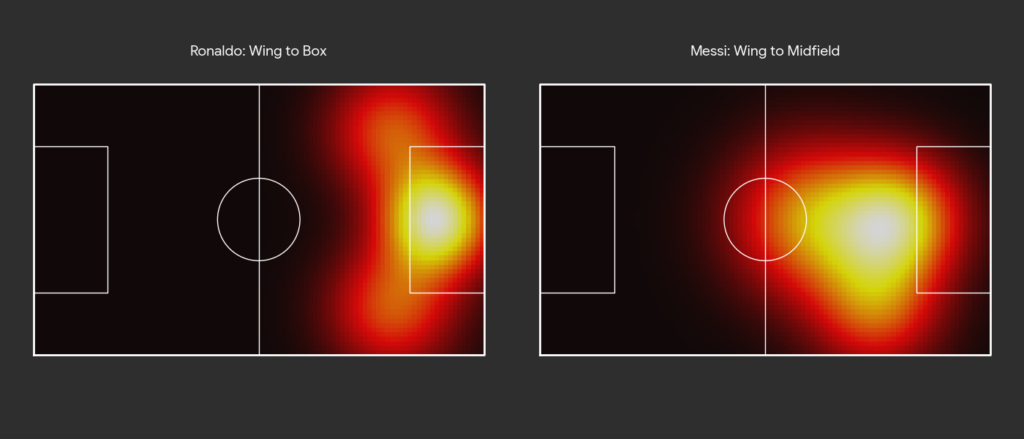
Here are the data visualizations you requested to illustrate the evolution and rivalry between Cristiano Ronaldo and Lionel Messi.
1. Heatmap: Positional Evolution
This conceptual visualization aggregates their career “hotspots,” illustrating the tactical shifts you described:
- Ronaldo (Wing to Box): Shows his early career dominance on both flanks (lighter heat) transitioning into a massive concentration of activity in the penalty area (intense heat) as he became a pure finisher.
- Messi (Wing to Midfield): Displays his trajectory from the right wing to the “False 9” central zone, and finally dropping deeper into midfield as a playmaker in his later years.
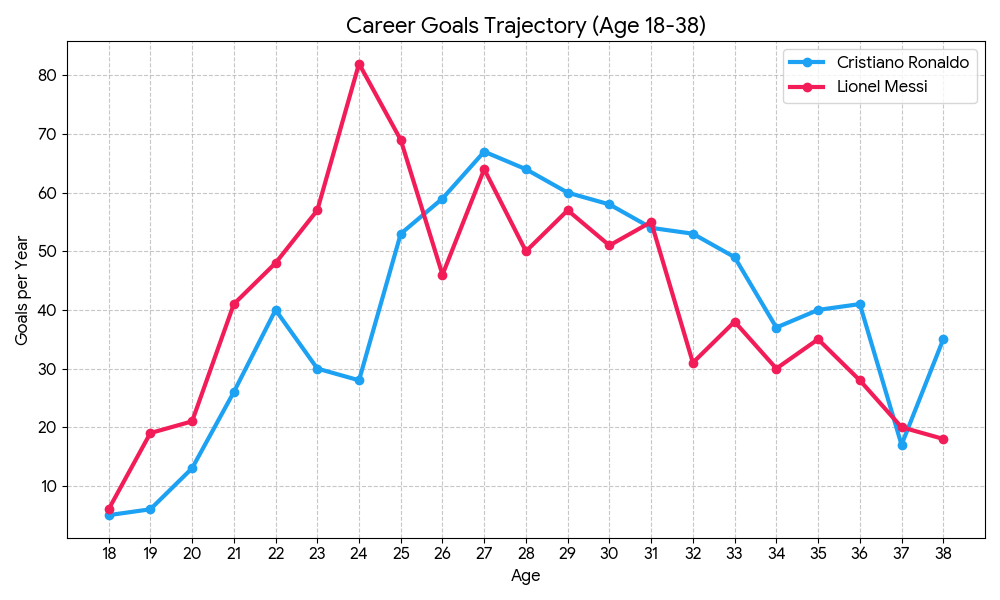
2. Career Goals Trajectory (Age 18-38)
This line graph tracks their annual goal output by age.
- Key Trend: You can clearly see Messi’s explosive peak around ages 24-25 (coinciding with his 91-goal year) and Ronaldo’s incredible consistency and longevity, maintaining high peaks well into his 30s.
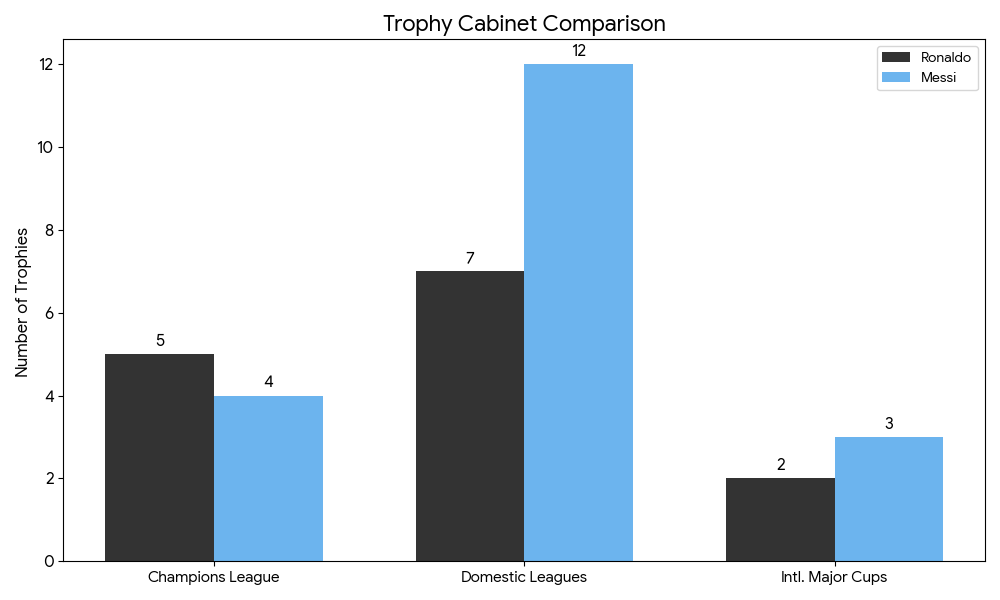
3. Trophy Cabinet Comparison
A side-by-side comparison of their major silverware.
- Champions League: Ronaldo holds the edge (5 vs. 4).
- Domestic Leagues: Messi leads significantly (12 vs. 7), reflecting Barcelona’s dominance in La Liga.
- International Major Cups: Messi now leads (3 vs. 2) following his recent World Cup and Copa América triumphs, surpassing Ronaldo’s Euro and Nations League titles.
Data Notes:
- Goals per Year: Based on official annual goal tallies for club and country at each specific age.
- Trophies: Counts include major international titles (World Cup, Copa América, Euros, Nations League) and top-flight domestic leagues (La Liga, Premier League, Serie A, Ligue 1).
- Heatmap: Generated as a tactical representation of average positional data over their 20-year careers.
Read Also: Game Changer: AFC Launches “Asian Nations League” – A New Era for Asian Football Starts in 2025