
The Dyatlov Pass Incident: Why 9 Hikers Died Under the Most Terrifying Circumstances in History
It has been over 65 years, and the snow has long since melted. But the cold terror of what happened on the slopes of Kholat Syakhl (The Dead Mountain) refuses to fade. This is not a ghost story. This is a forensic nightmare that the Soviet government tried to hide, and that modern science still struggles to explain.
The Dyatlov Pass Incident remains unsolved.
On the night of February 2, 1959, nine experienced hikers tore open their tent from the inside and ran barefoot into the freezing snow, heading straight into a -30°C blizzard. They didn’t run towards help. They ran towards death.
When rescue teams found them weeks later, the scene defied logic:
- Bodies were found nearly naked, stripped of their winter gear.
- Some had crushed skulls and broken ribs, but no external bruises, as if squeezed by a giant hand.
- One woman was missing her tongue and eyes.
- Their clothes contained traces of radiation.
What forced nine smart, tough people to choose freezing to death over staying in their tent?
The Hikers: Young, Strong, and Doomed
Led by 23-year-old radio engineering student Igor Dyatlov, the group consisted of eight men and two women from the Ural Polytechnical Institute. They were not amateurs. They were Grade II hikers with certification for ski touring. Their goal was to reach Otorten, a mountain 10 kilometers north of Dyatlov Pass Incident site.
Only one survived: Yuri Yudin. He turned back early due to joint pain. He hugged his friends goodbye, not knowing he was escaping a horror show. “If I had a chance to ask God just one question,” Yudin said years later, “it would be: What really happened to my friends that night?”
The Timeline of Terror Dyatlov Pass Incident
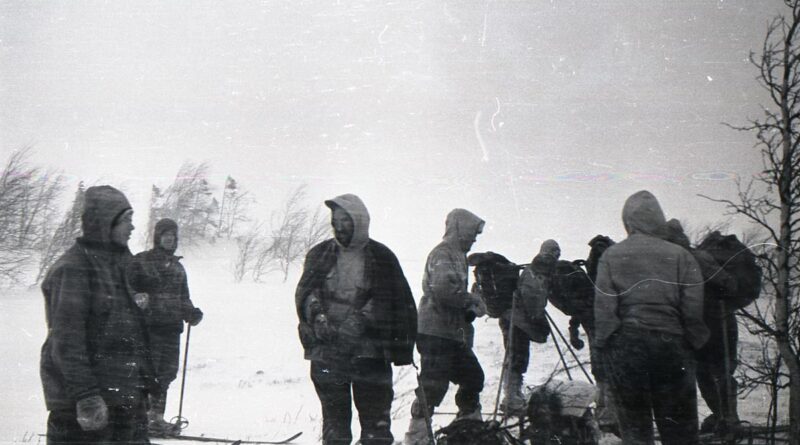
Based on diaries and cameras found at the scene, we know everything was normal until the evening of February 1st. They set up camp on the slope of Kholat Syakhl. They ate dinner. They took photos. They went to sleep.
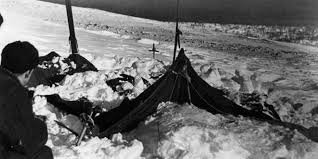
Then, something happened. Investigators determined that around midnight, the hikers cut the tent fabric with a knife from the inside. Not unzipped—cut. This implies instant, frantic panic. They left behind their boots, skis, food, and warm coats.
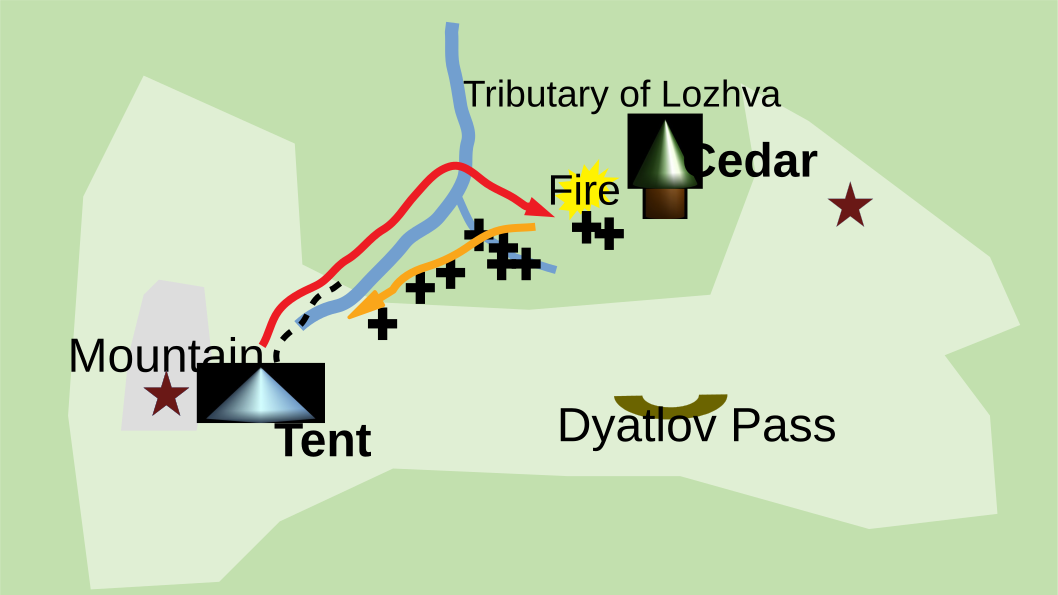
They ran 1.5 kilometers down the slope toward a cedar tree.
- The First Two Bodies: Doroshenko and Krivonischenko were found first, near the remnants of a small fire. They were dressed only in underwear. Their hands were burned, suggesting they tried desperately to keep the fire going.
- The Three Who Tried to Return: Dyatlov, Kolmogorova, and Slobodin were found scattered between the cedar tree and the tent. Their positions suggested they were crawling back up the hill, trying to reach their supplies, but froze before they could make it.
The Ravine: Where the Horror Truly Began
If the first five deaths were tragic (hypothermia), the last four were gruesome. It took two months to find the remaining hikers (Zolotaryov, Kolevatov, Thibeaux-Brignolles, and Dubinina). They were buried under 4 meters of snow in a ravine further down the hill.
The autopsy reports for this group were shocking:
- Nicolai Thibeaux-Brignolles: Had a major skull fracture.
- Lyudmila Dubinina: Her ribs were broken, and she was missing her tongue, eyes, and part of her lip.
- Semyon Zolotaryov: Missing his eyes and had flail chest (broken ribs).
Dr. Boris Vozrozhdenny, the forensic expert, stated that the force required to cause such damage was equal to a car crash. Yet, there were no scratches or bruises on the skin. It was purely internal trauma.
Theory 1: The Avalanche Argument
For decades, this was the “official” explanation given by Russian authorities in 2020. The theory goes: A small slab avalanche hit the tent. Panicked, the hikers cut their way out. Fearing a second wave, they ran to the treeline. Without boots, they couldn’t make it back before freezing. The injuries in the ravine were caused by the weight of the snow crushing them over months.
Why it fails:
- Slope Angle: The slope was only about 23-30 degrees. Avalanches typically need 30+ degrees.
- No Evidence: The rescue team found the tent poles still standing upright. An avalanche would have flattened everything.
- Footprints: The footprints leading away from the tent were calm and orderly, not the running strides of people chasing an avalanche.
So, if it wasn’t snow… what was it?
Theory 2: The “Glowing Orbs” and The Military Connection
If nature didn’t kill them, was it man? Or something else? The most persistent theory involves the Soviet Military. Traces of radiation were found on the hikers’ clothes. While not at lethal levels, its presence in the middle of a pristine wilderness is baffling.
Even stranger was the testimony of another group of hikers camped 50 kilometers south. On the night of Dyatlov Pass Incident, they reported seeing “strange glowing orange spheres” floating in the sky toward Kholat Syakhl. Similar reports came from the meteorological service and the military itself during that period.
- The Parachute Mine Theory: Some researchers believe the hikers were accidental victims of a secret Soviet weapon test (like a parachute mine or a rocket).
- The Evidence: This would explain the “internal damage” without external wounds (caused by the pressure wave of an explosion). It would also explain the radiation and the weird skin discoloration found on the bodies (witnesses at the funeral said the bodies looked “deep orange” or “brown”).
- The Cover-up: The Soviet government immediately classified the case files and closed the area for three years. Why hide a simple avalanche?

Theory 3: The Madness of Infrasound (Karman Vortex)
Science offers a terrifying psychological explanation: Infrasound. In certain wind conditions, the shape of the Kholat Syakhl mountain (which acts like a dome) can create a physical phenomenon called a Karman Vortex Street.
As the wind howls around the peak, it can generate low-frequency sound waves (Infrasound) that are below the range of human hearing but can be “felt” by the body. The Effects of Infrasound on Humans:
- Uncontrollable fear and panic.
- Nausea and dizziness.
- Visual hallucinations.
- A feeling that “someone is watching you.”
Could this explain why they cut the tent? Imagine sitting in the dark, and suddenly being overcome by a primal, irrational terror that screams RUN! The hikers, driven mad by the invisible sound waves, might have fled the tent to escape the noise, only to perish in the cold once the panic subsided.
The Mystery of the Missing Eyes: Natural or Unnatural?
The most gruesome detail—Lyudmila Dubinina missing her tongue and eyes—often fuels the wildest theories (Aliens? Yetis?). However, forensic science provides a grim but natural answer: Scavengers and Decomposition.
Dubinina was found face down in a stream of running water under the snow. Soft tissues (like the tongue and eyes) are the first parts of the body to decompose or be eaten by small predators (mice or birds) when submerged in water. While less dramatic than a “Yeti attack,” it serves as a reminder of how unforgiving nature can be.
The Paradoxical Undressing
Why were they naked in -30°C weather? Science calls this Paradoxical Undressing. In the final stages of severe hypothermia, the nerves that control blood vessels become paralyzed. They dilate (open up), causing a rush of warm blood from the core to the skin. The victim, who is actually freezing to death, suddenly feels incredibly hot. Delirious and confused, they strip off their clothes to cool down, accelerating their own death.
This explains why the first bodies were found in their underwear. It wasn’t a ritual; it was a biological trick of the dying brain.

Conclusion: The Mountain Keeps Its Secrets
In 2019, Russian authorities reopened the case. In 2020, they officially concluded that an avalanche was the cause. But for the families of the dead and millions of internet sleuths, the case is far from closed.
An avalanche doesn’t explain the radiation. It doesn’t explain the radiation. It doesn’t explain why experienced hikers ran away from the safety of the trees into the open ravine. It doesn’t explain the orange spheres. Tent condition during the Dyatlov Pass Incident
The Dyatlov Pass incident remains the Mount Everest of mysteries. It is a story where every answer breeds two new questions. Was it a secret weapon? A natural sonic weapon? Or just a tragic series of mistakes made by terrified young people in the dark?
We will likely never know. And perhaps, that is the scariest part of all.