
Be Kind, Rewind: Why Netflix Will Never Match the Magic of a Friday Night at Blockbuster
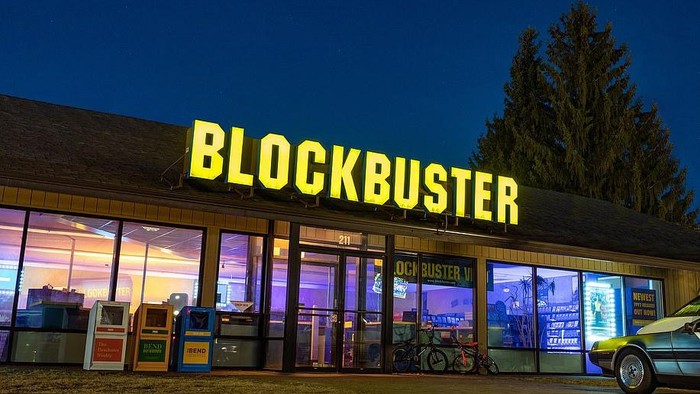
If you were alive in the 90s or early 2000s, you know this feeling. It is Friday night. The school week is over. Your parents just ordered a Pizza Hut (the kind with the stuffed crust). And as you pile into the family minivan, you are heading to the local strip mall to perform the weekly sacred ritual: Visiting Blockbuster Video.
Streaming services like Netflix and Disney+ are convenient, sure. You have 10,000 movies at your fingertips without leaving your couch. But let’s be honest: They are soulless. They lack the sensory experience of Blockbuster. The faint smell of artificial popcorn butter, cheap carpet, and ozone. The blindingly bright fluorescent lights reflecting off thousands of plastic cases. The distinct “clack” sound of a VHS box snapping shut. It wasn’t just about watching a movie; it was about the hunt.
The Thrill of the Hunt (Scarcity vs. Abundance) Modern psychology tells us that too much choice creates anxiety (The Paradox of Choice). That is why we spend 45 minutes scrolling through Netflix only to watch The Office for the 10th time.
Blockbuster solved this through Scarcity. Walking the aisles was an adventure. You didn’t have an algorithm telling you what to watch. You judged a movie solely by its cover art and the blurry synopsis on the back. The “New Releases” wall was the battlefield. You would sprint to the aisle hoping to find a copy of Jurassic Park or Titanic. The ultimate heartbreak wasn’t buffering; it was grabbing a box, looking behind it, and realizing the actual tape was missing—rented out by someone 5 minutes faster than you. But when you did find that last copy hidden behind another box? You felt like Indiana Jones finding the Holy Grail.
The Video Game Section: A Gambler’s Den For the geeks, the movie section was just an appetizer. The main course was the Game Rental section. Games were expensive ($60 in 1998 money was a lot). So, we rented them for $5 for three days. Renting a cartridge (SNES or N64) was a gamble. You didn’t know if the previous kid had deleted the save file. Sometimes, you’d rent Final Fantasy and find a save file with maxed-out characters at the final boss. Other times, you’d rent Pokemon Stadium only to find someone nicknamed “BUTTHEAD” had released all the rare Pokemon. It was a community experience, connected by a plastic cartridge.
The Ultimate Villain: Late Fees Of course, we cannot romanticize Blockbuster without mentioning the villain: The Late Fees. Blockbuster’s business model was essentially banking on human procrastination. The “Be Kind, Rewind” stickers on the tapes were passive-aggressive threats. Returning a tape un-rewound cost you $1. Returning it three days late felt like you needed to take out a second mortgage.
In the year 2000 alone, Blockbuster made $800 Million just from late fees. That is roughly 16% of their total revenue. They weren’t in the movie business; they were in the “punishing you for being lazy” business.
The $50 Million Mistake (How They Died) This greed was their undoing. In 1997, a man named Reed Hastings was charged $40 in late fees for returning Apollo 13. He was so angry that he founded a company that had no late fees. He called it Netflix.
In 2000, Reed Hastings met with the CEO of Blockbuster, John Antioco. Hastings offered to sell Netflix to Blockbuster for $50 Million. The Blockbuster executives literally laughed him out of the room. They thought streaming and mail-order DVDs were a joke. Today, Netflix is worth over $200 Billion, and Blockbuster is a memory. It is the biggest “Oops” in corporate history.
The Last Blockbuster The empire collapsed in 2010. Thousands of stores closed. The blue-and-yellow signs were torn down. But one survived. In Bend, Oregon, the last Blockbuster on Earth is still open. It operates as a tourist attraction and a functioning video store. It has become a holy site for 90s kids, selling merchandise and nostalgia to people desperate to smell that carpet one last time.
Conclusion We don’t miss the late fees. We don’t miss the scratched discs. But we miss the event. Visiting Blockbuster was a social activity. You ran into neighbors. You argued with your siblings over which movie to pick. You flirted with the cute cashier. Netflix gives us content, but Blockbuster gave us a memory. And no amount of bandwidth can stream the feeling of holding a physical copy of a movie on a Friday night.
Read Also: The 1,000-Mile Charge: Why 2025 Marks the Death of “Range Anxiety” for EVs