
Meticulous Evil: Court Docs Reveal Bondi Attackers Planned “Tennis Ball Bomb” Carnage and Left ISIS-Style Manifesto
SYDNEY — The horrific attack that turned Australia’s iconic Bondi Beach into a war zone last week was not a spontaneous act of madness, but a “meticulously planned” terror operation involving homemade explosives and a chilling digital manifesto, new court documents revealed on Monday.
As the nation emerges from a weekend of mourning, the narrative surrounding the tragedy has shifted dramatically. What was initially feared to be a random act of violence has now been confirmed by the New South Wales Police and federal intelligence agencies as a calculated strike against the Jewish community, orchestrated by a father and son who had managed to slip through the cracks of Australia’s national security net.
The revelations, detailed in a police facts sheet tendered to the court this morning, paint a terrifying picture of what could have happened if the attackers’ crude technology had not failed them at the critical moment.
The “Tennis Ball” Bombs: A Plan for Mass Casualties
The most harrowing detail to emerge from Monday’s court filing is the discovery of an arsenal of Improvised Explosive Devices (IEDs) carried by the perpetrators, identified as 24-year-old Naveed Akram and his father, Sajid Akram.
According to police forensics, the pair arrived at the bustling beachside precinct armed not only with high-powered firearms but with a backpack containing what investigators are calling “tennis ball bombs.”
These crude but deadly devices were constructed by hollowing out standard tennis balls and packing them with explosive powder and shrapnel—likely nails or ball bearings—before being fitted with a simple fuse. The tactical intent, police allege, was to hurl these grenades into the dense crowds gathered for the Hanukkah lighting ceremony from the vantage point of the pedestrian overpass, causing mass confusion and casualties before opening fire.
“The intent was maximum lethality,” a senior police source told reporters outside the court. “They wanted to herd the crowd with explosions.”
Miraculously, technical incompetence saved countless lives. The court documents indicate that the fuses on the improvised devices failed to ignite properly or the explosive mixture was chemically unstable. Several unexploded devices were recovered by the bomb squad in the chaotic aftermath of the siege, rolling harmlessly on the pavement where families had been standing just moments before.
Had these devices detonated as intended, experts estimate the casualty count—currently standing at 15 tragic deaths—could have easily tripled.
The Digital Evidence: A “Martyrdom” Manifesto
For days, the media and the public have speculated about the motive. Was it mental health? Was it a personal grievance? The contents of Naveed Akram’s mobile phone, deciphered by cyber-forensics teams over the weekend, have provided a definitive and chilling answer.
Investigators recovered a video file recorded in mid-October 2025, nearly two months prior to the attack. In the footage, the younger Akram is seen dressed in tactical gear, brandishing the semi-automatic rifle used in the massacre.
The backdrop of the video is not a suburban bedroom, but a black flag bearing Arabic script, stylistically mimicking the iconography used by the Islamic State (ISIS). In the manifesto, Naveed calmly pledges allegiance to the extremist ideology and explicitly outlines his intention to target “Zionis” and “enemies of the faith” in Sydney.
“This was not a snap decision,” the prosecution argued in court today. “This video demonstrates a long gestation period of radicalization. They rehearsed this. They planned this. They waited for a specific date on the calendar.”
The existence of this video dismantles the early theory that the attackers were “lone wolves” acting on impulse. It suggests a deep-seated radicalization process that occurred right under the nose of the community, likely accelerated by online echo chambers.
The Intelligence Failure: “We Missed Him”
Perhaps the most infuriating aspect of Monday’s revelations is the confirmation that this was not the first time Naveed Akram had crossed the radar of Australian intelligence services.
Prime Minister Anthony Albanese, facing a furious public and a shaken Jewish community, confirmed reports that the Australian Security Intelligence Organisation (ASIO) had investigated the younger attacker as far back as 2016.
At that time, Naveed was a teenager. He had been flagged for “concerning online behavior” and interactions with known radical networks on social media. However, after a risk assessment, he was deemed a “low-level priority” and dropped from active surveillance.
“The system blinked,” said one security analyst on national television. “You have a known person of interest who, nine years later, is able to acquire a firearms license, purchase ammunition, and construct bombs without raising a single red flag. That is not a crack in the system; that is a chasm.”
The revelation has triggered an immediate and aggressive review of Australia’s gun laws and the national watchlist database. Questions are being asked about how the National ongoing firearms license checks failed to flag the previous ASIO interest. The Premier of New South Wales has already promised a “root and branch” review of the entire firearms registry system.
A Community in Shock
While the court dealt with the cold, hard facts of forensics and motives, the human toll of the tragedy continues to ripple through Sydney.
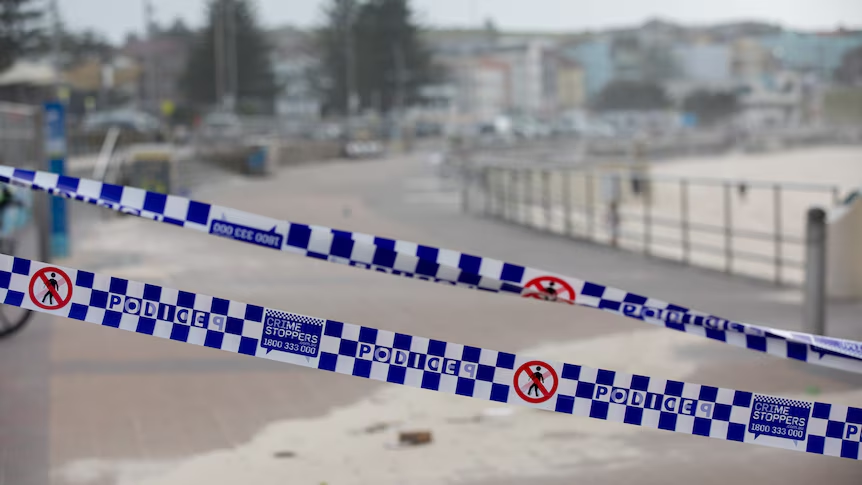
Bondi Beach, usually the symbol of Australia’s laid-back, sun-soaked lifestyle, remains a crime scene. The pedestrian overpass where the attackers stood is now draped in flowers, Israeli flags, and Australian boxing kangaroos—a symbol of resilience.
Yesterday, a massive vigil was held at the site. Thousands of Sydneysiders, from all faiths and backgrounds, stood in silence as the sun went down over the Pacific Ocean. The mood was one of disbelief. Bondi is a place of surfboards and sunscreen, not body armor and bombs.
“We come here to forget the world’s problems,” said Sarah Jenkins, a local resident who attended the vigil. “To think that someone brought a war into our backyard… it changes everything. I don’t know if I’ll ever look at this beach the same way again.”
The Road Ahead
As the legal process begins—likely to be a posthumous inquiry given the death of both attackers at the scene—Australia faces an uncomfortable reckoning.
The details released today confirm that the threat of domestic terrorism has evolved. It is no longer just about sophisticated international networks; it is about the quiet, “meticulous” planning that happens in suburban garages, fueled by online hate and missed by intelligence agencies overwhelmed by data.
For the victims’ families, the news that the attack was planned months in advance adds a new layer of pain. It wasn’t an accident. It was a targeted, hateful mission that, despite the failure of their bombs, succeeded in shattering the innocence of a nation.
Daily Dejavu will continue to monitor the court proceedings and the upcoming government inquiry into the intelligence failures.
Read Also: Game Changer: AFC Launches “Asian Nations League” – A New Era for Asian Football Starts in 2025