The Silicon Curtain Falls: Inside China’s Secret “Manhattan Project” That Just Shattered the US Tech Blockade
SHENZHEN — In a high-security laboratory on the outskirts of Shenzhen, a machine the size of a school bus began to hum. It wasn’t just any mechanical noise; it was the sound of the global order shifting.
A blinding violet light—Extreme Ultraviolet (EUV)—was successfully fired.
To the average person, this might sound like an obscure physics experiment. But to policymakers in Washington, executives in Silicon Valley, and engineers in Veldhoven, Netherlands, this is a nightmare scenario coming to life.
Exclusive reports released by Reuters on the first day of 2026 have confirmed what Western intelligence agencies have long feared: China has successfully built a prototype of its own EUV Lithography machine.
This machine is the “Holy Grail” of modern technology. For years, the United States has used the blockade of this specific technology as its primary weapon to choke China’s industrial rise. The logic was simple: If we stop ASML from selling these machines to Beijing, their tech industry will starve.
It turns out, that strategy may have been the most spectacular backfire in modern geopolitical history. Instead of starving, the Chinese dragon learned to hunt for itself.
At Daily Dejavu, we are peeling back the layers of this clandestine operation to understand how China achieved the impossible—from the spy-thriller recruitment tactics to the sheer engineering complexity—and what this means for the future of the world.
Part I: The Most Complex Machine on Earth
To understand the gravity of this breakthrough, one must first understand the machine itself. An EUV Lithography system is widely considered the most complex piece of hardware ever constructed by human hands.
It is not a simple printer. It is a machine that paints circuits the size of a DNA strand onto silicon wafers.
- The Scale: It prints transistors that are 3 nanometers wide. To put that in perspective, a human hair is 100,000 nanometers wide.
- The Method: It doesn’t use a lightbulb. It generates light by dripping molten tin into a vacuum chamber and blasting it with a high-power CO2 laser 50,000 times per second. The tin explodes into plasma, which emits the EUV light.
For the last two decades, only one company in the world possessed the mastery to build this: ASML in the Netherlands. They held a 100% monopoly. Without an ASML machine, you cannot build the chips that power the latest iPhones, NVIDIA’s AI processors, or hypersonic missile guidance systems.
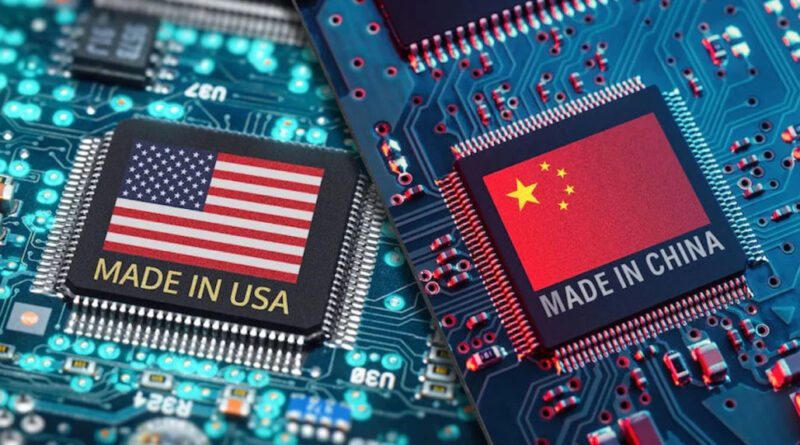
The US government knew this. That is why the ban on exporting EUV technology to China was the cornerstone of the “Chip War.” It was supposed to be the checkmate. Today’s news confirms: The checkmate failed.
Part II: China’s “Manhattan Project”
How did China catch up on 20 years of R&D in just 6 years? The answer involves a mix of unlimited state funding, desperate necessity, and a covert operation that reads like a spy novel.
Insiders refer to this initiative as China’s “Manhattan Project.” Just as the US mobilized its entire scientific community to build the atomic bomb in secret during WWII, Beijing mobilized its entire tech sector for semiconductor survival.
1. The General: Huawei
If ASML is the king of the West, Huawei is the general of the East. Battered by US sanctions since 2019, Huawei was designated by President Xi Jinping to lead this survival mission. The company coordinated thousands of engineers from state research institutes, operating with a wartime mentality. They weren’t working for profit; they were working for existence.
2. The Method: Reverse Engineering
According to the Reuters report, the Chinese team employed aggressive Reverse Engineering techniques. The intelligence community suspects that despite the sanctions, China managed to acquire older machine parts, deconstruct them, and study their “DNA.” They stripped down every bolt, every lens, and every cable to understand the physics behind the magic.
3. The Shadow Recruitment
This is the most controversial aspect of the breakthrough. Investigations reveal that China didn’t just steal the blueprints; they bought the brains. Since 2019, the Chinese government has reportedly offered signing bonuses ranging from 3 million to 5 million Yuan ($400,000 – $700,000) in cash to foreign semiconductor experts.
The primary targets? Former ASML engineers. Reports suggest that veteran engineers from the Netherlands and the US were recruited to work in Shenzhen under fake names and forged identities.
- Compartmentalization: These foreign experts often worked in isolated silos. Even their colleagues in the same facility did not know their real names. This extreme secrecy was designed to protect them from international lawsuits and CIA/FBI surveillance.
Part III: The Last Hurdle – The “Zeiss” Problem
While the prototype in Shenzhen is operational, the battle is not entirely won. There remains one “Final Boss” that China must defeat to achieve mass production.
The report notes: “The machine generates Extreme Ultraviolet light, but it has not yet produced commercially viable chips. China still faces significant technical challenges, particularly in replicating the high-precision optical systems.”
In Western machines, the mirrors are supplied by the German company Carl Zeiss AG. These are not ordinary mirrors. They are the flattest objects on Earth.
- The Precision: If a Zeiss mirror were expanded to the size of the entire country of Germany, the biggest bump on it would be less than 1 millimeter high.
Part IV: A Geopolitical Earthquake
The existence of this prototype is a devastating indictment of US foreign policy.
Two US administrations—Trump and Biden—operated under the strategy of “Containment.” The theory was that by cutting off access to advanced tech, China’s development would freeze.
In reality, the sanctions acted like a Vaccine. At first, the vaccine caused a fever (Huawei’s sales dropped, the industry struggled). But over time, it forced China’s system to develop immunity. The trillions of dollars that China used to spend importing chips from the West were redirected into domestic R&D.
A source familiar with the project told Reuters: “The goal is for China to eventually make advanced chips with machines that are entirely made in China. They want the US kicked 100% out of their supply chain.”
If China succeeds in mass-producing these machines by 2030, US sanctions will become toothless. Worse for the West: China could flood the global market with advanced, legacy-free chips at a fraction of the cost, destroying the profit margins of Intel, Micron, and Samsung.
Part V: The Bipolar Tech World
We are witnessing the end of the Unipolar tech world, where all roads led to Silicon Valley. We are entering a Bipolar era:
- The Western Block: Using US/European standards (Intel, NVIDIA, ASML). Highly advanced, but expensive and heavily regulated by licenses and politics.
- The Eastern Block: Using Chinese standards (Huawei, SMIC). Cost-effective, sanction-proof, and rapidly improving.
Developing nations in Southeast Asia, Africa, and South America will soon face a difficult choice:
- Build AI infrastructure cheaply using Chinese chips? (Risking data security accusations from the West).
- Or pay a premium for Western tech? (Risking being cut off if political winds change).
Conclusion: The Genie is Out of the Bottle
There is an old saying: “Necessity is the mother of invention.” By blocking China’s access, the US created the “Necessity.” Now, China has delivered the “Invention.”
The prototype in Shenzhen might still be rough around the edges. It might not be as efficient as the latest ASML model. But remember the history of the atomic bomb. From the first Trinity test in 1945 to the deployment of a functional weapon took less than a month. From a rough prototype to mass production, China has a track record of terrifying speed (look at how they dominated the EV market with BYD and Xiaomi).
2026 opens with a red alert for Western technological dominance. It took ASML 20 years to get here. China did it in 6. What happens in the next 4?
One thing is certain: The Silicon Curtain has fallen. And behind the rubble, a new technological superpower has officially awakened.