Your Doctor is Now an Algorithm: How “Digital Twins” Are Predicting Heart Attacks Before They Happen
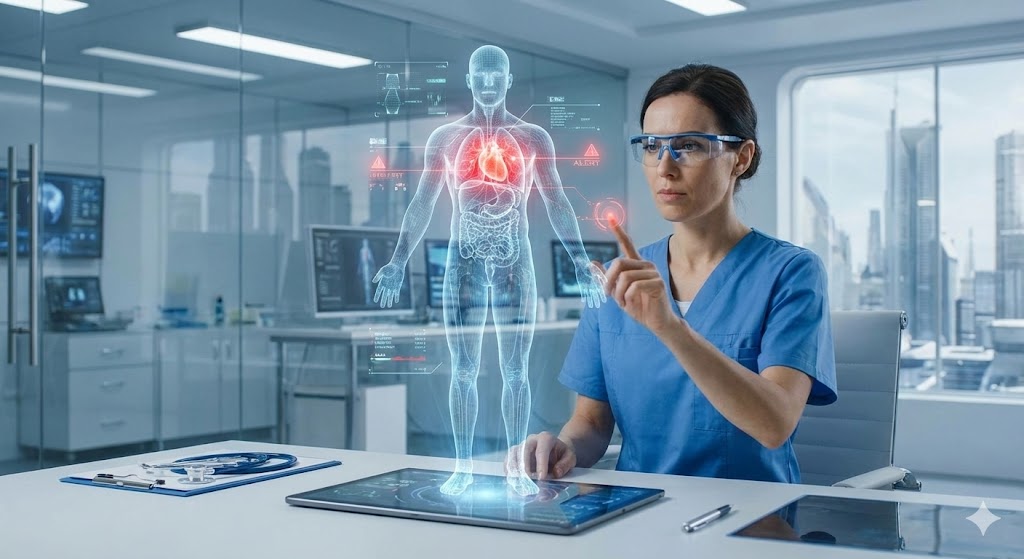
In the past, the relationship between a patient and a doctor was reactive. You felt a sharp pain in your chest, you went to the hospital, and the doctor tried to fix what was broken. Medicine was a repair shop. But in late 2025, the paradigm of modern medicine has fundamentally shifted from “cure” to “prediction.”
Welcome to the era of the Medical Digital Twin. For decades, NASA used digital twin technology to simulate spacecraft repairs on Earth before touching the real rocket millions of miles away in space. Now, thanks to the explosion of AI computing power and wearable sensors, that same technology is being applied to the most complex machine in the known universe: the human body.
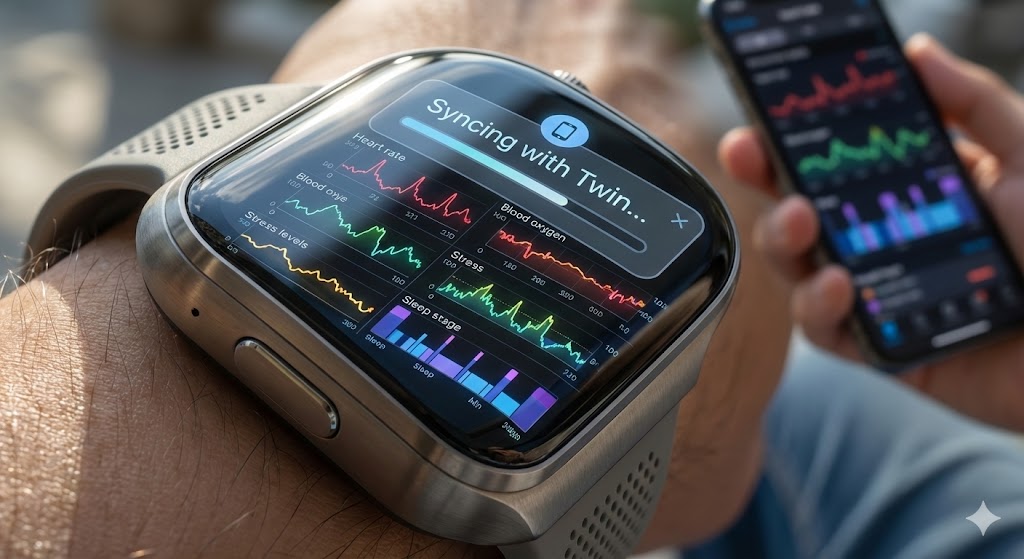
What is a Digital Twin? (It’s Not Just a 3D Model) A Digital Twin is a virtual, dynamic replica of you. It is not simply a static 3D scan of your skeleton. It is a living, breathing simulation fed by a constant stream of real-time data from your ecosystem of devices: your smartwatch, your smart ring, your continuous glucose monitor (CGM), and even your smart mattress.
“By 2025, we are no longer guessing,” says Dr. Elena Rostova, a lead researcher at the Zurich Institute of Computational Medicine. “Your Digital Twin runs thousands of simulations every night while you sleep. It calculates the probability of a heart attack based on your stress levels yesterday, your diet today, and your genetic markers from your DNA test.”
Think of it as a flight simulator for your health. Before a doctor prescribes a strong blood pressure medication, they test it on your Digital Twin first to see if there are side effects, sparing your real body from the trial-and-error process.
The End of “Sudden” Illness The most groundbreaking application seen this year is in Cardiovascular Health. Hospitals in Boston and London have started pilot programs where high-risk patients are monitored solely through their twins. The results are staggering.
In a recent Q3 2025 trial, the AI successfully predicted Atrial Fibrillation (AFib)—a dangerous irregular heartbeat—in patients three days before the symptoms appeared. The algorithm noticed subtle patterns in heart rate variability (HRV) that no human cardiologist could spot. The doctors adjusted the medication remotely, and the stroke never happened. The heart attack was prevented because the code saw it coming miles away.
Pharmacogenomics: The End of “One Size Fits All” One of the biggest failures of traditional medicine is the “One Size Fits All” approach. A pill that cures one person might kill another due to genetic differences. Digital Twins solve this through Pharmacogenomics.
By combining your full genome sequence with your real-time metabolic data, your Digital Twin can predict exactly how fast your liver will process a drug. In 2025, we are seeing the rise of “Hyper-Personalized Drugs.” Pharmacies are beginning to 3D print pills with custom dosages specific to your Digital Twin’s recommendation. You don’t take 500mg because that’s what the bottle says; you take 423mg because that is exactly what your body needs
The Privacy Nightmare: The Billion-Dollar Question Of course, this technological marvel comes with a heavy price tag: your privacy. To make a Digital Twin work, you have to surrender everything. Your DNA, your heart rate, your sleep patterns, even your bathroom habits. This raises the terrifying question of “Biological Data Rights.”
If an algorithm knows you have a 90% chance of developing Alzheimer’s in five years, does your insurance company have the right to know too? In 2025, the debate is heating up in the US Congress and the EU Parliament. Insurance companies are lobbying for access to “Risk Scores” generated by Digital Twins.
- The Nightmare Scenario: Imagine applying for life insurance and being rejected not because you are sick, but because an AI simulation predicted you might get sick in 2030. For now, the technology is moving significantly faster than the laws can keep up.
The Wearable Connection This revolution relies heavily on the sensors we wear. As we discussed in our article about the [Analog Rebellion], while some are ditching tech, the majority are embracing “Invisible Health Tech.” Smart contact lenses that measure glucose from tears and earrings that track blood oxygen levels are becoming standard. These devices are the “food” that keeps the Digital Twin alive. Without data, the twin starves and becomes inaccurate.
The Verdict Despite the ethical gray zones and privacy terrors, the adoption rate is exploding. The promise of living a longer, healthier life by outsourcing your health monitoring to an AI is simply too tempting to ignore.
As we move deeper into this decade, one thing is clear: The best doctor in 2025 isn’t the one with the stethoscope around their neck. It’s the code running in the cloud, watching over you 24/7, predicting the storm before the first drop of rain falls.