
Beyond the Tipping Point: Why 2025 Marked the Start of “The Great Boiling”
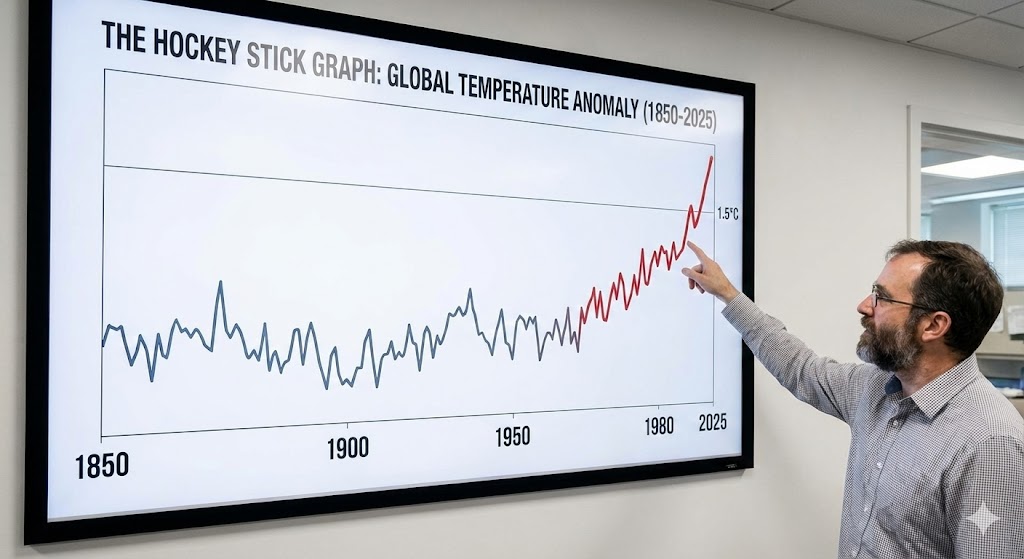
GENEVA — For decades, scientists warned us in polite, measured tones. They used charts, graphs, and diplomatic terms like “Climate Change” or “Global Warming.” They gave us targets: 1.5°C above pre-industrial levels. They gave us deadlines: 2030, 2050.
But as we celebrate Christmas in 2025—with record-breaking heatwaves hitting the Southern Hemisphere and bizarre, snowless winters in parts of Europe—it is time to admit the uncomfortable truth. The diplomatic era is over.
We have officially entered the era of “Global Boiling.”
This year wasn’t just another hot year in the ledger. 2025 will likely be remembered by historians as the psychological and physical tipping point—the year the thermostat broke, and the year humanity realized that mitigation had failed, and only survival remained.
At Daily Dejavu, we are stripping away the political rhetoric to look at the raw data, the technological paradoxes, and the terrifying economic reality of Earth 2.0.
Part I: The Death of 1.5°C
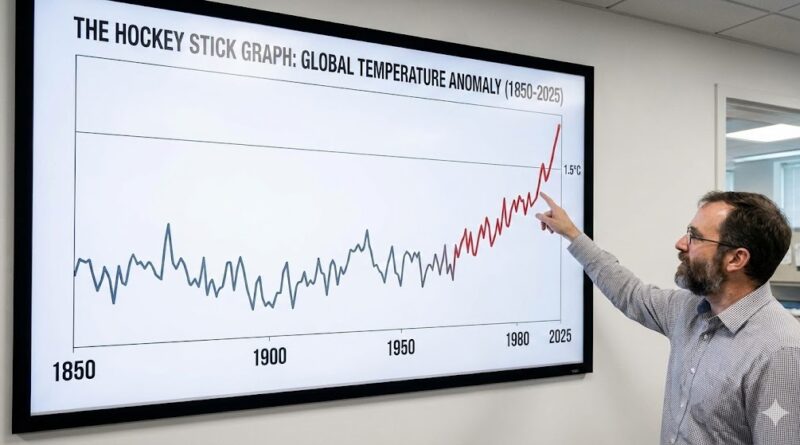
Let’s rip the band-aid off immediately: The 1.5°C target is effectively dead.
For years, the Paris Agreement held this number as the “safe” limit. Crossing it meant entering a danger zone of feedback loops. In 2024, we flirted with it. In 2025, we lived it.
Data from the Copernicus Climate Change Service confirms that for the first time, the 12-month average global temperature has consistently breached the 1.6°C threshold. The “anomaly” has become the baseline.
The Feedback Loops
The scariest part isn’t the heat itself; it’s what the heat triggers. We are seeing the activation of irreversible tipping points:
- The Albedo Loss: As Arctic sea ice vanishes (hitting record lows this September), the dark ocean absorbs more sunlight instead of reflecting it, heating the planet even faster.
- Permafrost Methane Bomb: In Siberia and Canada, the frozen ground is thawing, releasing megatons of Methane—a greenhouse gas 80 times more potent than CO2 in the short term.
We are no longer driving the car gravity has taken over.
Part II: The AI Energy Paradox
Here lies the cruelest irony of 2025. Just as we desperately need technology to solve the climate crisis, our newest obsession—Artificial Intelligence—is setting the planet on fire.
The explosive growth of Generative AI and Large Language Models (LLMs) has triggered an unprecedented hunger for electricity. Data centers are the new smokestacks.
- The Data: A standard Google search uses 0.3 watt-hours of energy. A ChatGPT query uses nearly 10 times that amount.
- The Scale: As corporations race to integrate AI into everything from toasters to traffic lights, global data center energy consumption has doubled since 2022.
In Virginia, USA (the data center capital of the world), utility companies are delaying the retirement of coal plants just to keep the servers running. We are burning dead dinosaurs to fuel digital brains. While Silicon Valley executives preach about “AI for Sustainability,” their infrastructure is arguably one of the biggest drivers of the current emission spike.
Part III: The “Blue-Lining” Event (Insurance Collapse)
Forget what politicians say; watch where the money goes. The most honest industry in the world is the Insurance Industry. They don’t care about feelings; they care about risk.
In 2025, we witnessed a phenomenon economists are calling “Blue-Lining.” Major insurance giants—State Farm, Allstate, AXA—have quietly stopped writing new policies for vast swathes of the planet.
- Florida & California: Uninsurable due to hurricanes and wildfires.
- Jakarta & Bangkok: Uninsurable due to sinking ground and rising seas.
When you cannot insure a house, you cannot get a mortgage. When you cannot get a mortgage, the real estate market collapses. We are standing on the precipice of a global property crash led not by subprime loans, but by physics. The rich are moving to “Climate Havens” (like New Zealand or the Great Lakes), while the poor are left with uninsurable assets in sinking cities.
Part IV: The Wet-Bulb Terror
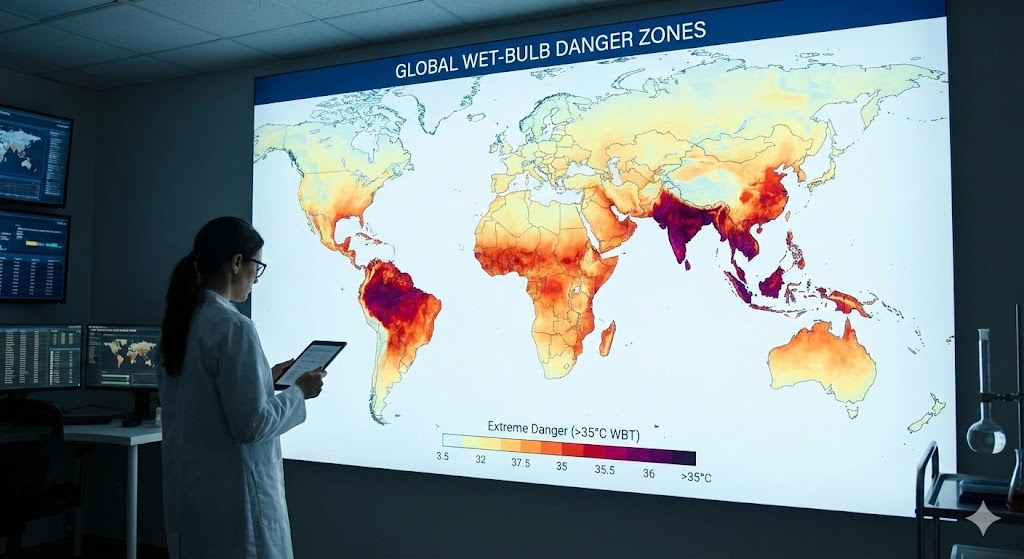
The heat of 2025 introduced a new term to the public lexicon: Wet-Bulb Temperature.
Humans cool down by sweating. But when heat combines with 100% humidity, sweat cannot evaporate. The body cooks from the inside out. The theoretical limit for human survival is a wet-bulb temperature of 35°C.
This year, parts of the Persian Gulf, Pakistan, and India briefly touched this lethal limit. We are seeing the beginning of “Thermal Migration.” It’s not just uncomfortable weather; it’s biologically uninhabitable weather. By 2030, vast regions of the tropics may become “No-Go Zones” for human life during summer months, triggering migration waves that will make the 2015 refugee crisis look like a dress rehearsal.
Part V: Desperate Measures (Geoengineering)
With emissions still rising and targets missed, the conversation in 2025 has shifted to the “Forbidden Solution”: Solar Geoengineering.
Governments are no longer whispering about it; they are funding it. The concept is simple but terrifying: Mimic a volcanic eruption by injecting sulfur dioxide into the stratosphere to block sunlight and cool the Earth artificially.
- The Risk: It works, but it disrupts global rainfall patterns. Cooling North America might accidentally turn the Amazon Rainforest into a desert or fail the Indian Monsoon, starving millions.
- The Geopolitics: Who gets to control the global thermostat? If China decides to cool Beijing but causes a drought in the US Midwest, is that an act of war?
We are entering an era where controlling the weather is no longer science fiction, but a geopolitical weapon.
Conclusion: Adaptation is the New Mitigation
This article is not meant to inspire hope in the traditional sense. Hope requires action, and on the mitigation front (cutting emissions), humanity has largely failed to act with the necessary speed.
The focus of the late 2020s must shift to Radical Adaptation.
- Building sea walls, not just solar panels.
- Breeding heat-resistant crops, not just planting trees.
- Redesigning cities for “sponge” water absorption.
The Earth of 1990 is gone. It is not coming back. We are living on Earth 2.0—a more hostile, volatile, and energetic planet. The question for the rest of the decade is not “How do we stop it?” but “How do we survive it?”
As the year closes, look at the weather outside your window. Memorize it. Because in the era of Global Boiling, “normal” is a luxury we can no longer afford.