
The $20 Million Meow: The True Story of “Acoustic Kitty,” the CIA’s Failed Cyborg Cat Spy
The Cold War was a time of absolute paranoia. The USA and Russia were locked in a silent battle for information. They built U-2 spy planes. They dug tunnels under Berlin. They developed invisible ink and poison dart umbrellas. They would try anything to get an advantage.
But nothing—absolutely nothing—proves the sheer insanity of the era quite like “Operation Acoustic Kitty.” In the 1960s, the CIA Directorate of Science and Technology had a brilliant idea. They looked at a household cat and thought: “It’s quiet. It can go anywhere without suspicion. People talk freely in front of it. Let’s turn it into a living tape recorder.”
It sounds like a joke from an Austin Powers movie. But declassified documents from 2001 reveal it was very, very real.
The Logic: The Perfect Infiltrator To understand why they did this, you have to understand the limitations of 1960s tech. Surveillance bugs were huge. You couldn’t just stick one under a table without risking detection. But a cat? A stray cat wandering up to a park bench where two Soviet agents were whispering? Nobody would bat an eye. It was the perfect camouflage. The only problem was turning the animal into a transmitter.
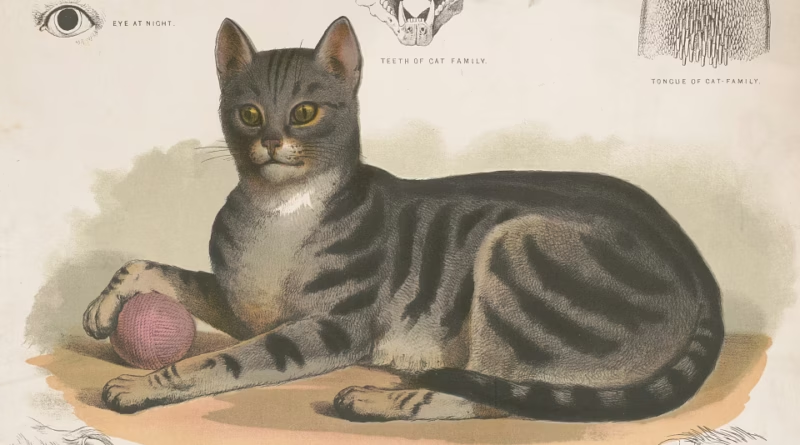
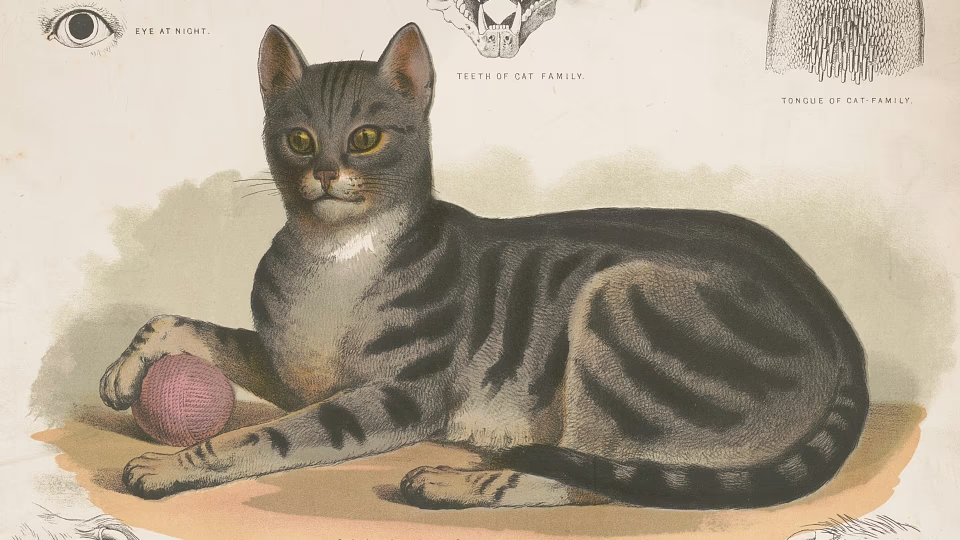
The Cyborg Surgery (Frankenstein Style) This wasn’t just tying a recorder to a collar (which would be too obvious). The CIA wanted the tech to be inside the cat. In a procedure that would horrify modern veterinarians, CIA surgeons spent hours operating on a grey-and-white female cat.
- The Ear: They implanted a microphone directly into the cat’s ear canal to capture audio.
- The Skull: They placed a radio transmitter at the base of the skull.
- The Fur: They wove a thin wire antenna all the way down the cat’s tail to broadcast the signal.
- The Body: Batteries were implanted in the chest cavity.
The project took five years of research and surgery. The cost? An estimated $20 million (adjusted for inflation). It was a marvel of miniaturization. Technically, they had created the world’s first cyborg biological agent.
The Training Problem: Cats Are Not Dogs The hardware worked. The agents could hear what the cat heard. But then they ran into a software problem: The Cat itself. Anyone who owns a cat knows they are not like dogs. You cannot tell a cat, “Go sit by that Russian guy.” The cat will go sit where it wants.
During early tests, the cat would wander off the job to hunt for food. So, the CIA scientists performed another surgery to suppress the cat’s hunger sensation, hoping it would focus on the mission. They effectively tried to override millions of years of evolutionary instinct with a budget and a scalpel.
The First Mission: The Taxi Incident Finally, after years of development and millions of dollars, the cyborg cat was ready for its first field test. A CIA surveillance van parked near a park on Wisconsin Avenue in Washington, D.C. The target: Two men (allegedly Soviet assets) sitting on a bench deep in conversation.
The agents opened the van door. They deployed “Acoustic Kitty.” The cat took a few steps. It didn’t head toward the bench. It wandered into the street. And then, in a moment of dark, cosmic comedy, it was immediately hit and killed by a passing taxi.
Five years of work. $20 million in funding. Top-tier surgical engineering. All wiped out in 15 seconds by a yellow cab.
The Cover-Up and Declassification The agents scraped up the remains of their expensive equipment and drove away. The project was cancelled shortly after. For decades, this story was a rumor. But in 2001, heavily redacted documents were released thanks to the Freedom of Information Act.
The official report concluded with a rare moment of bureaucratic honesty:
“Our final examination of trained cats… convinced us that the program would not lend itself in a practical sense to our highly specialized needs.” Translation: Cats do not take orders from the federal government.
Conclusion “Operation Acoustic Kitty” stands as a monument to Cold War hubris. It proves that you can have the smartest engineers and the biggest budget in the world, but you cannot conquer nature. Today, we use drones that look like hummingbirds or dragonflies. They are effective, battery-powered, and obedient. But somewhere in history, there is a $20 million cyborg cat that gave its life to teach the CIA a very simple lesson: If you want loyalty, get a dog.
“Read Also: The Tamagotchi Trauma: How a Pixelated Egg Taught Us About Death“