
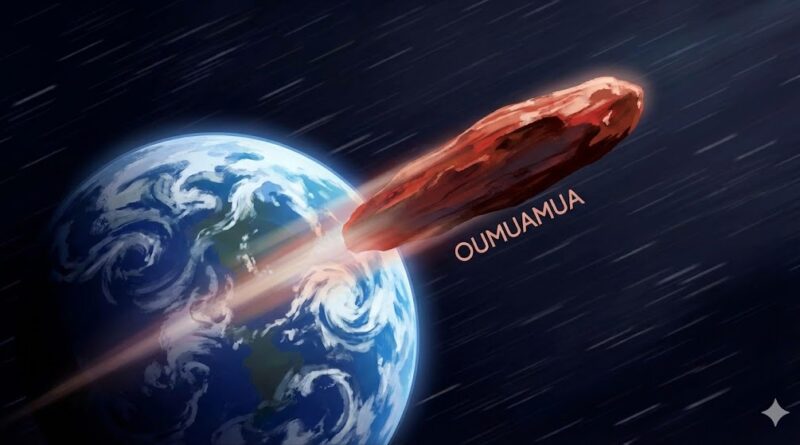
Why Harvard’s Top Astronomer Insists ‘Oumuamua Was Alien Technology
On October 19, 2017, the Pan-STARRS telescope in Hawaii detected a faint point of light moving across the sky. At first glance, it looked like just another rock in a solar system full of them. But as astronomers tracked its orbit, they realized something terrifyingly exciting: It wasn’t from here.‘Oumuamua Was Alien Technology
This object, later named ‘Oumuamua (Hawaiian for “Scout” or “Messenger from afar”), had come from deep interstellar space. It dove toward our Sun, looped around it, and shot back out into the void at a speed of 196,000 miles per hour.
It was the first interstellar object humanity had ever detected. History was made. But the celebration quickly turned into confusion. ‘Oumuamua didn’t behave like a comet. It didn’t behave like an asteroid. It broke the rules of orbital mechanics.
While mainstream science scrambled for natural explanations, one man stood up with a controversial theory. Avi Loeb, the Chair of the Astronomy Department at Harvard University, proposed the unthinkable: ‘Oumuamua wasn’t a mistake of nature. It was a piece of technology built by an extraterrestrial civilization. You can read more about the Harvard Theory Explained in this analysis.
The Discovery That Shook Astronomy
To understand why ‘Oumuamua is so strange, you have to understand how boring normal space rocks are. Comets are balls of ice and dust. Asteroids are chunks of metal and rock. We have tracked millions of them. We know exactly how they move.
A Speed That Defied Gravity
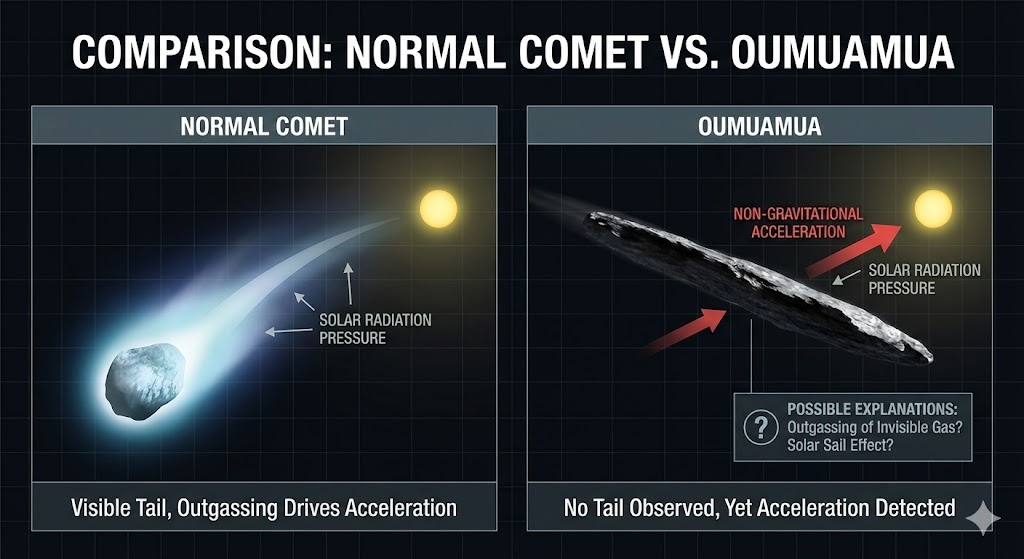
When an object falls toward the Sun, gravity pulls it in. As it slingshots around the Sun, it flies out. The speed is calculable. But ‘Oumuamua did something impossible: It accelerated. As it moved away from the Sun, it gained speed. It was being pushed by a mysterious force that gravity alone could not explain.
The Missing Tail
Normally, comets accelerate because they heat up. The ice melts into gas, creating a visible “tail” that acts like a natural rocket engine (a process called outgassing). Astronomers pointed every telescope on Earth at ‘Oumuamua, looking for this tail. They found… nothing. There was no gas. No dust. No water vapor. It was a “dead” object. Yet, it was accelerating as if it had an engine.
The “Solar Sail” Theory: Science or Fiction?
If it wasn’t gas pushing the object, what was it? Prof. Avi Loeb crunched the numbers. He realized there was only one force in the universe that could explain the movement without mass loss: Solar Radiation Pressure.
Harnessing the Power of Light
Just as wind pushes a fabric sail on a boat, particles of light (photons) from the Sun bounce off reflective surfaces, creating a tiny amount of push. For this to work on a rock, the rock would need to be impossibly thin—less than a millimeter thick—and incredibly wide. Like a sheet of paper floating in the wind.
Artificial by Design?
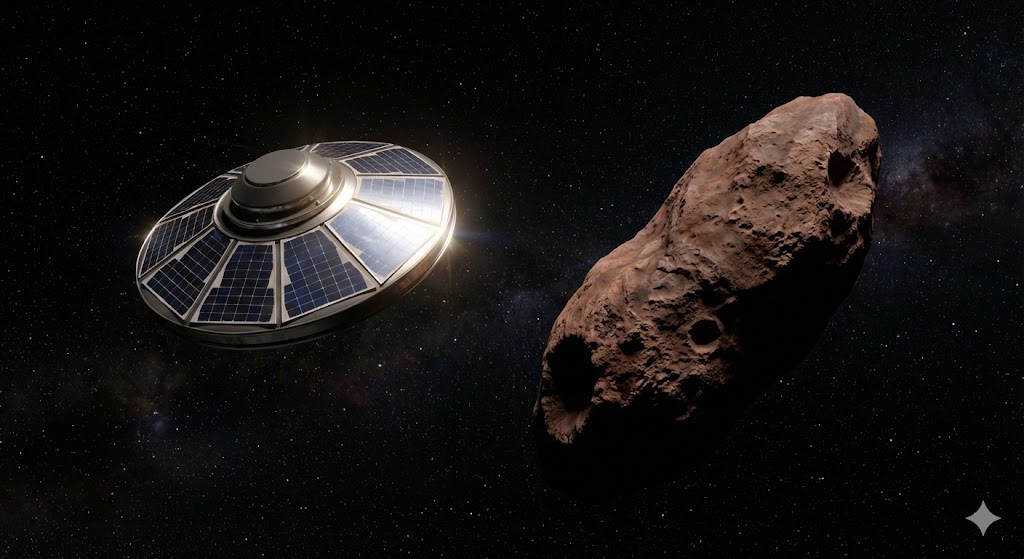
Nature doesn’t make rocks that look like giant sheets of paper. But engineers do. We call them Light Sails or Solar Sails. NASA and the Japanese space agency (JAXA) have already tested them. Loeb’s hypothesis was simple: ‘Oumuamua accelerated because it was a light sail catching the Sun’s rays. If true, this implies it was manufactured.
The Shape Mystery: Cigar or Pancake?
The strangeness didn’t stop at speed. The shape of ‘Oumuamua was unlike anything we had ever seen. Because the object was too small to resolve as more than a dot of light, astronomers determined its shape by measuring how its brightness changed as it tumbled.
- The Brightness Drop: Every 8 hours, ‘Oumuamua’s brightness dimmed by a factor of 10.
- The Implication: For an object to dim that much as it spins, it must be extremely elongated.
Initial models suggested a cigar shape, 10 times longer than it was wide. Later models suggested it was shaped like a flat pancake. Either way, the probability of a rock naturally forming into a perfect cigar or a perfect flat disk is statistically close to zero.
The Mainstream Counter-Arguments
Extraordinary claims require extraordinary evidence. The scientific community fought back hard against Loeb’s “Alien” theory.
The “Hydrogen Iceberg” Theory
In 2020, researchers attempted to explain the acceleration by suggesting ‘Oumuamua was a chunk of solid hydrogen ice. The theory was that hydrogen gas is invisible to telescopes, which would explain why we didn’t see a tail.
- The Problem: Hydrogen ice is extremely volatile. Prof. Loeb argued that a chunk of hydrogen ice would have evaporated long before it ever reached our solar system after traveling millions of years through interstellar space.
[H3] The “Dust Bunny” Theory
Others suggested it was a loose clump of “fractal dust” that was incredibly lightweight, like a cosmic dust bunny.
- The Problem: An object that fragile would likely have been torn apart by the intense spinning motion ‘Oumuamua exhibited.
Conclusion: The Galileo Project and The Future
‘Oumuamua is now beyond the orbit of Neptune, forever out of reach. We will never know for sure what it was. But its legacy is permanent. It forced science to confront a bias: Why do we assume everything is a rock?
In response to the ridicule, Avi Loeb founded The Galileo Project. This is not science fiction. It is a network of telescopes and high-resolution cameras specifically designed to scan the sky for “Unidentified Aerial Phenomena” (UAP) and future interstellar visitors. This reminds some of the mystery behind the Dyatlov Pass Incident, a tragedy that still has no clear explanation.
The next time a visitor enters our solar system, we won’t just watch it fly by. We will be ready to take a picture. And if that picture shows smooth metal instead of craggy rock, human history will change in an instant. The implications of discovering AI or alien technology are immense, and the future is uncertain.