
The Concrete Jungle Goes Green: Singapore Opens World’s First 80-Story
t’s 2025, and the global conversation has shifted dramatically from “preventing climate change” to “surviving it.” With traditional supply chains fractured by increasingly erratic weather patterns over the last few years, cities worldwide have faced a terrifying question: How do we feed millions of people when the farms are underwater or baked dry?
This week, Singapore gave a stunning answer that is reverberating around the globe.
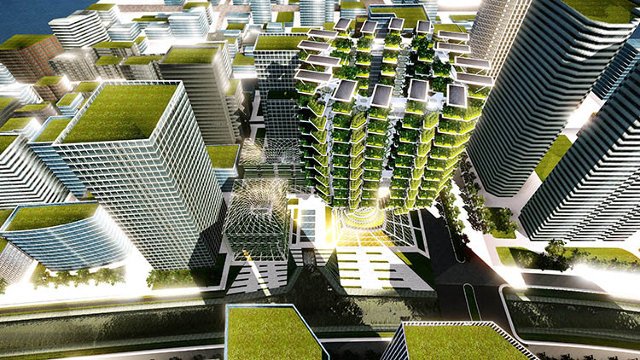
In the heart of the dense Marina Bay district, where steel and glass used to dominate, a new kind of spire has officially opened its doors. It’s called The Genesis Tower, and it is the world’s first true “Farmscraper”—an 80-story vertical ecosystem designed to feed a city that has almost no land.
A Verdant Spire in the City
For decades, vertical farming was a neat concept constrained to warehouses and shipping containers. The Genesis Tower changes the scale entirely. It doesn’t hide the food production; it celebrates it.
From the outside, the tower looks like something out of a solarpunk novel. Cascading terraces of rice paddies and leafy greens wrap around the building’s exterior, while enormous glass atriums glow with the eerie magenta hue of high-efficiency LED grow lights, working 24/7.
According to Singapore’s Ministry of Sustainability, this single building, occupying a footprint smaller than a football field, is projected to produce enough leafy greens, herbs, and certain fruits to supply 30% of the entire nation’s needs.
The Tech: AI Farmers and Zero Soil
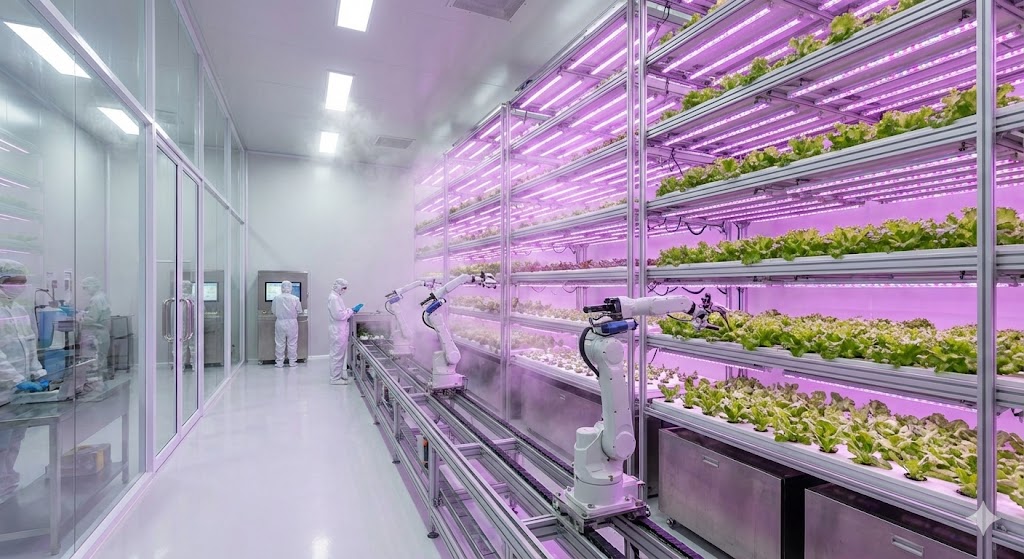
Walking inside the Genesis Tower feels less like entering a greenhouse and more like stepping into a clean room at a microchip factory.
The true genius of the tower isn’t the height; it’s the integration of the AI breakthroughs we saw mature in 2023 and 2024. The entire operation is managed by “Demeter,” a central AI system.
There is almost no soil in the entire building. Crops are grown using advanced aeroponics—roots hanging in the air, misted with precise nutrient solutions.
- Robotic Orchestration: We watched as a swarm of small, silent robots moved along tracks on the 45th floor, scanning each individual lettuce head for signs of disease and harvesting them at the exact peak of ripeness. No human hands touch the food until you buy it.
- Climate-Agnostic: “It could be a typhoon outside, or a 50-degree heatwave,” says Dr. Anya Sharma, lead agronomist for the project. “Inside here, it is always a perfect spring day. We have eliminated the weather variable from agriculture.”
- Water Recycling: Perhaps most crucially for 2025, the tower uses 95% less water than traditional farming, recycling virtually every drop of moisture transpired by the plants.
The Global Ripple Effect
The opening of the Genesis Tower is not just local news; it’s a geopolitical statement. For history, food security has meant national security. By decoupling food production from landmass, Singapore is rewriting the rules.
Major cities renowned for their density and lack of arable land—such as Dubai, New York, and Mumbai—have already sent delegations to tour the facility.
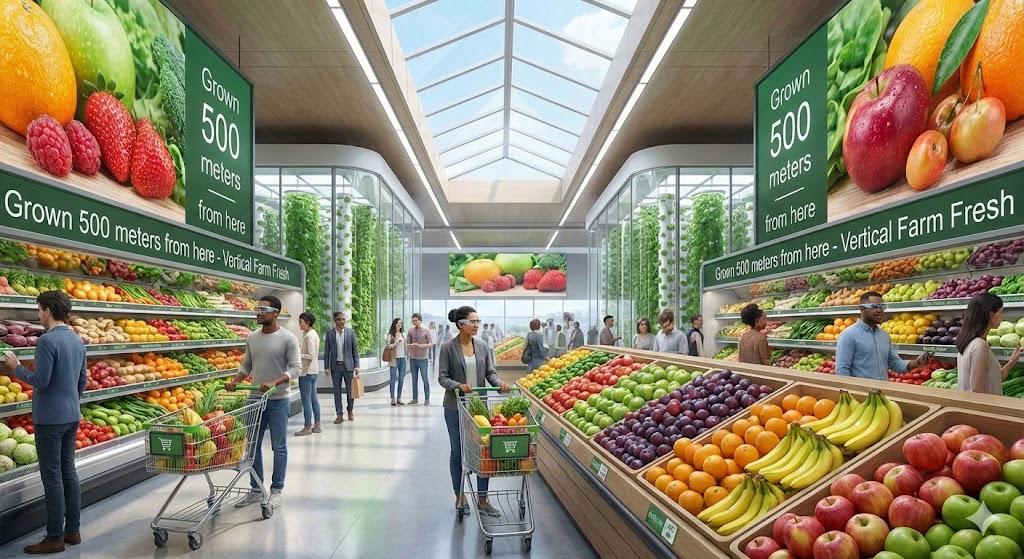
“We are looking at the end of the ‘rural-to-urban’ food supply chain,” remarked an urban planner from London attending the launch. “Why ship a tomato 3,000 miles when you can grow it 30 stories above the supermarket where it’s sold?”
The Taste of the Future
Critics used to argue that lab-grown or vertical-farmed food lacked soul or flavor. But in 2025, faced with the alternative of expensive, scarce, and often climate-damaged traditional produce, consumers are flocking to Genesis-grown food.
The produce is hyper-local. It’s harvested on floor 60 at 8 AM and is on plates in the city’s restaurants by noon. It is fresher than anything humanity has known since the industrial revolution.
The Genesis Tower stands as a massive, living monument to human adaptability. It is a stark reminder that the world has changed, but it’s also a hopeful beacon showing that our technology might just be able to keep up.
What do you think? Would you eat a salad grown by robots on the 50th floor, or do you miss the idea of a traditional farm? let us know in the comments.