
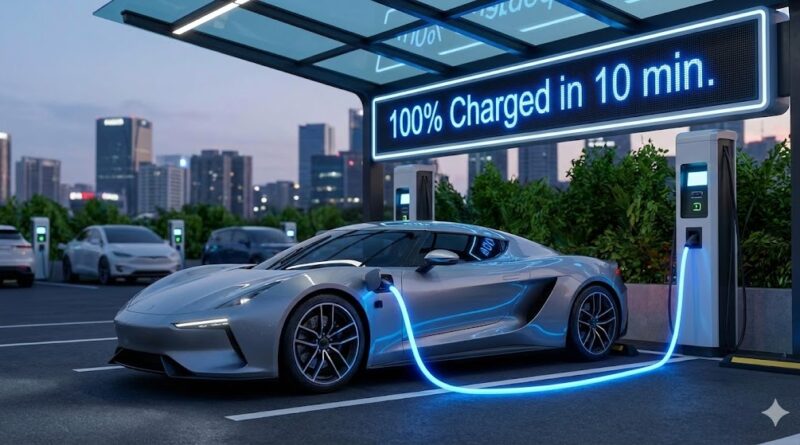
The 1,000-Mile Charge: Why 2025 Marks the Death of “Range Anxiety” for EVs
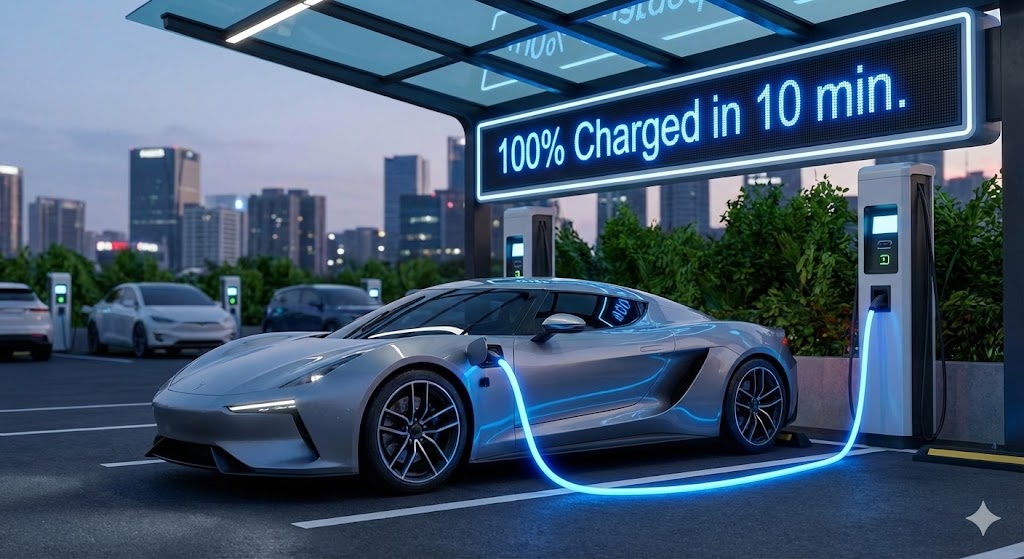
For the last decade, the biggest argument against buying an Electric Vehicle (EV) was simple, primal fear: “What if I run out of power in the middle of nowhere?” It was a valid fear. We called it “Range Anxiety.” It kept millions of drivers clinging to their gas-guzzling SUVs because, let’s be honest, waiting 45 minutes at a charging station in the rain was nobody’s idea of progress.
But 2025 will go down in history books not for a war or an election, but as the year that argument officially died. The long-awaited “Holy Grail” of energy storage—Solid-State Batteries (SSBs)—has finally moved from the secrecy of the laboratory to the dealership floor. The Internal Combustion Engine (ICE) didn’t die with a bang; it died with a quiet hum.
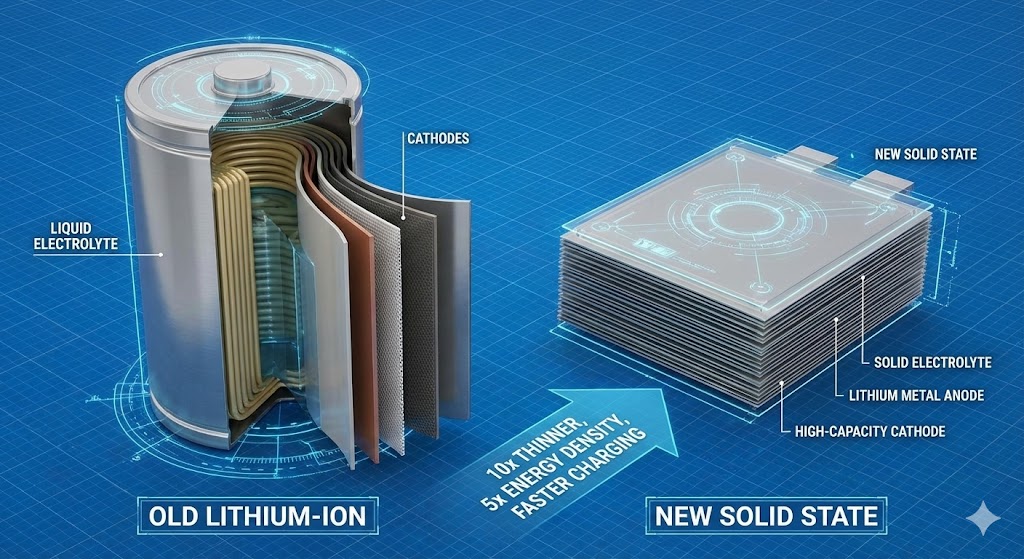
Liquid vs. Solid: Understanding the Chemistry To understand why this is a revolution, we need a quick chemistry lesson. Since the invention of the modern smartphone, we have relied on Lithium-Ion batteries. These batteries use a liquid electrolyte to move ions between the cathode and anode. While they served us well, liquid batteries have fatal flaws: they are heavy, they are sensitive to temperature, and if the separator fails, the liquid creates “dendrites” (spiky crystal formations) that cause short circuits and fires.
Solid-state technology changes the game completely. It replaces that volatile liquid with a solid ceramic or glass material. The difference is not just an upgrade; it is a generational leap, similar to moving from Hard Disk Drives (HDD) to SSDs.
- Density: They hold 3x the energy in the same physical space.
- Safety: They are virtually fireproof. You could drive a nail through these batteries, and they wouldn’t explode.
- Longevity: They can survive 5,000+ charge cycles with minimal degradation.
The 1,000-Mile Club: A New Standard Toyota and QuantumScape have dominated headlines this month with the release of the first mass-market prototypes for the 2026 model year. The specs are absolutely terrifying for the fossil fuel industry.
The new standard isn’t 300 miles. It’s 900 to 1,000 miles (1,600 km) on a single charge. To put that in perspective: You could drive from London to Rome without stopping to plug in. You could drive from New York to Chicago on a single charge. “Range Anxiety” has effectively been replaced by “Bladder Anxiety”—the car can now drive longer than the human inside it can survive without a bathroom break.
The 10-Minute Fill Up Range is great, but speed is king. Legacy EVs required 30-40 minutes at a Supercharger to reach 80%. “We have achieved a 10% to 80% charge in under 9 minutes,” claimed the CEO of a leading battery tech firm in Silicon Valley yesterday.
This is the tipping point. Nine minutes is roughly the time it takes to pull into a gas station, pump fuel, go inside to use the restroom, and buy a coffee. The “convenience gap” between gas and electric has officially closed.
Beyond Cars: Smartphones That Last a Week While cars get all the media attention, this tech is trickling down to our pockets faster than expected. Major smartphone manufacturers (rumored to include Apple and Samsung) are prepping flagship devices for late 2025 powered by micro-solid-state cells.
Imagine a phone that is thinner than a credit card because it doesn’t need a bulky safety shell for the battery. Imagine a smartwatch that you only need to charge once a month. Or a drone that can stay in the air for 4 hours instead of 20 minutes. This technology will fundamentally redesign every portable device we own.
The Economic Earthquake: The End of the Oil Age? Economists predict that Q4 2025 is the start of the “Great Decoupling” from oil. For a century, gasoline had one massive advantage: Energy Density. It packed a lot of power into a small liquid volume. Solid-state batteries have finally challenged that monopoly.
When an EV is cheaper to run, safer to drive, lasts for 500,000 miles, and can travel further than a gas car without stopping, the internal combustion engine loses its sole purpose. Gas stations are already pivoting. Shell and BP are rapidly converting pumps into high-speed charging hubs, adding cafes and lounges because they know the business model of “pump and go” is fading.