
The End of Slaughter: Why Your Next Steak Will Be Grown in a Steel Tank (And Why That’s a Good Thing)
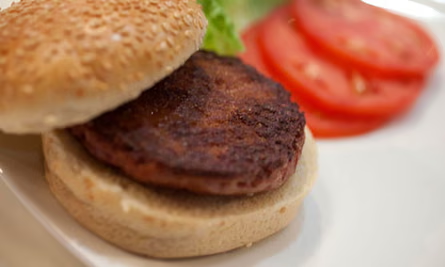
For 10,000 years, the recipe for a steak has remained unchanged: Raise a cow, feed it tons of grain and water for two years, and then slaughter it. It is an inefficient, resource-intensive, and morally complicated process. To get 1 calorie of beef, you need to input roughly 25 calories of feed. If you designed a machine that inefficient, you would be fired.
But in late 2025, science has finally offered a viable alternative. It goes by many names: Cultivated Meat, Cell-Based Meat, or Lab-Grown Meat. Whatever you call it, the promise is the same: Real meat, without the misery. The abattoir is being replaced by the laboratory.
It’s Not “Fake” Meat (Understanding the Science) The biggest misconception—and the one marketing teams fight every day—is confusing this with “Plant-Based” meat.
- Plant-Based (Impossible/Beyond): Uses soy, pea protein, and beet juice to mimic the taste and texture of meat. It is botany.
- Cultivated Meat: Is 100% animal meat. Under a microscope, a cell from a lab-grown steak is identical to a cell from a cow in a field. It is biology.
The process sounds like science fiction. Scientists take a small biopsy of cells (the size of a sesame seed) from a living animal (who is unharmed). These cells are placed in a massive steel tank called a Bioreactor, fed a nutrient-rich broth of amino acids and sugars, and warmed. The cells do what they do naturally: they multiply. In a few weeks, that sesame seed becomes tons of muscle tissue.
(H2) The Environmental Math: Saving the Planet Why go through all this trouble? Because our current system is unsustainable. Industrial animal agriculture is responsible for nearly 14.5% of all global greenhouse gas emissions (more than all cars and planes combined). It uses 70% of the world’s fresh water.
Cultivated meat flips this math on its head. Early studies suggest that at scale, lab-grown meat could use:
- 95% less land
- 78% less water
- 92% less global warming potential Imagine returning millions of acres of farmland to nature (rewilding forests) because we no longer need to grow corn just to feed cows.
The Approval: From Singapore to the USA This isn’t just a concept anymore. You can eat it today (if you are lucky). Singapore was the pioneer, approving the sale of GOOD Meat chicken nuggets back in 2020. The USA followed suit recently, with the FDA and USDA granting approval to companies like UPSIDE Foods to sell their cultivated chicken fillets to high-end restaurants in San Francisco and Washington D.C.
It is safer, too. Because it is grown in a sterile environment, there is zero risk of E. coli, Salmonella, or fecal contamination—issues that plague traditional slaughterhouses.
The Hurdles: Price and the “Uncanny Valley” If it’s so great, why isn’t it in your supermarket? Two reasons: Cost and Culture.
- The Price Tag: The first lab-grown burger in 2013 cost $330,000 to produce. Today, the price has dropped to about $20 per serving, but that is still far more expensive than a $5 Big Mac. Until they can build bioreactors the size of oil refineries, it will remain a luxury item.
- The “Yuck” Factor: Humans are skeptical of new food. Critics call it “Frankenmeat.” There is a psychological barrier to eating something that “grew in a tube.” However, proponents argue: “Is a sterile steel tank really grosser than a slaughterhouse floor covered in blood and manure?”
The Future: Customizing Your Food The most exciting part is not just copying meat, but improving it. Since we control the process at the cellular level, we can tweak the nutritional profile. Imagine a Wagyu beef steak that has the heart-healthy Omega-3 fatty acids of a salmon, instead of saturated fat. Imagine eating bacon without the cholesterol. In the future, we won’t just ask “Medium or Rare?”; we will ask “Standard or Enhanced?”
Conclusion We are witnessing the “Kodak Moment” of agriculture. Just as digital cameras made film obsolete, cultivated meat threatens to make factory farming a relic of the past. It will take time. But in 30 years, our grandchildren might look at us with horror when we tell them we used to kill animals to get dinner. The future of food is here. It’s delicious, it’s cruelty-free, and it’s growing in a tank near you.
Read also: Jurassic Park is Coming: Scientists Are Bringing the Woolly Mammoth Back to Life