
Why 2020 Feels Like Yesterday: The Neuroscience of Why Time Speeds Up As We Age (And How to Slow It Down)
Do you feel like 2020 was just last week? Does it freak you out that 1990 was over 35 years ago? If you recently looked at a calendar and felt a sudden wave of existential panic, you aren’t going crazy. You are experiencing a very real psychological phenomenon.
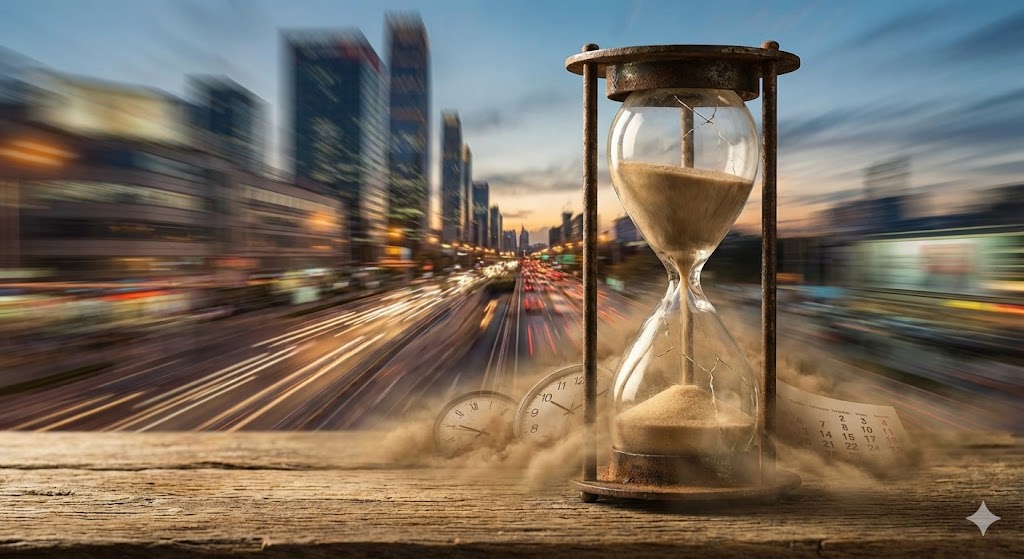
As children, summer holidays felt like they lasted for an eternity. An afternoon playing video games felt like a saga. But as adults, decades seem to slip by in the blink of an eye. Christmas comes, you blink, and it’s Easter. You blink again, it’s Christmas again. Why is our brain hitting the “Fast Forward” button? The answer lies in a mix of mathematics, biology, and our addiction to routine.
The Mathematics: Pierre Janet’s Law The first explanation is purely mathematical. It’s called the “Proportional Theory” (or Janet’s Law). We perceive time relative to how long we have been alive.
- At age 5: One year represents 20% of your entire existence. It is a massive chunk of data.
- At age 50: One year represents only 2% of your life. It is a tiny fraction. Because each new year is a smaller percentage of the total, it feels subjectively shorter. We are living on a logarithmic scale, but we feel linearly.
The “Routine” Trap: The Brain’s Autopilot However, math is only half the story. The real culprit is your brain’s obsession with efficiency. Neuroscientists explain that the brain is a pattern-recognition machine. It craves novelty but settles for routine.
When you are a child, everything is new. The first time you ride a bike, the first day of school, the first kiss. Your brain records these events in High Definition. It writes dense, rich memories because it’s learning survival skills. As adults, we fall into “The Loop.” Wake up, coffee, commute, office, commute, Netflix, sleep. Repeat. Your brain says: “I’ve seen this commute 1,000 times. I don’t need to record it.” It stops writing new memories. It switches to Autopilot. When you look back at the last 5 years, your brain collapses all those duplicate days into one single blurry memory file. The years didn’t actually go fast; you just didn’t record enough unique frames.
The Digital Black Hole: Scrolling Away Time In 2025, we have a new enemy of time: The Screen. We discussed the fake nature of social media in our [Zombie Feed] article, but screens also destroy time perception. When you “doomscroll” on TikTok or Instagram, you enter a state of flow with zero novelty. You consume thousands of pieces of information, but your brain retains none of it. This is “Digital Amnesia.”
Have you ever sat down to check your phone for “5 minutes” and realized an hour had passed? That is time deletion. By constantly distracting ourselves, we are robbing our brains of the “boredom” that actually makes time feel long.
The Holiday Paradox This leads to the famous “Holiday Paradox.” When you go on an exciting vacation to a new country, the days fly by fast because you are having fun. BUT, when you return and look back, the vacation feels long. Why? Because you created New Memory Markers. Conversely, a boring week at the office drags on slowly while you are there, but when you look back on Friday, the week seems to have vanished instantly. Rule of Thumb:
- Routine: Slow in the moment, fast in retrospect.
- Novelty: Fast in the moment, long in retrospect.
How to Hack Your Brain (Slow Down Time) So, is it hopeless? Are we destined to speed toward death at Mach 10? No. You can slow it down. The secret is to force your brain off Autopilot.
- Seek Novelty: Go to a restaurant you’ve never been to. Take a different route to work. Learn a skill you suck at (like coding or painting). New inputs force the brain to start recording in High Definition again.
- Digital Detox: Put the phone down. Boredom expands time. Staring out a window for 10 minutes feels longer than scrolling for 10 minutes.
- Shock the System: Cold showers, intense exercise, or public speaking. Adrenaline creates “flashbulb memories” that anchor time.